Gold Eagle Coin 1 oz
In a world where digital numbers on a bank screen can change in a heartbeat, many people look for a tangible asset they can actually hold in the palm of their hand. Historically, precious metals have provided that physical reassurance when financial markets feel overly complex or unpredictable. For families wanting to protect a nest egg or give a lasting wedding gift, the gold eagle coin stands out as the ideal starting point. It represents an accessible, physical form of savings that feels incredibly different from a standard paper bank statement.
Why does a coin that clearly says “$50” on the back actually cost thousands of dollars to purchase? This fascinating quirk highlights the important difference between everyday currency and gold bullion. While currency refers to the paper money or standard coins you use to buy daily necessities, bullion is a financial term for precious metals valued entirely by their weight and purity rather than their printed face value. Even though this specific coin is technically legal tender, its true worth is driven by the global market price of the physical metal contained inside it.
According to the United States Mint, the American Eagle program was specifically designed to give the public a safe, domestic option for purchasing precious metals. Authorized by the Gold Bullion Coin Act of 1985, every single one of these pieces comes with a crucial advantage: the U.S. government strictly guarantees its weight, content, and purity. This means buyers never have to worry about complex metal testing or authenticity concerns, because the full faith and credit of the nation stands firmly behind the product.
Imagine you eventually want to pass this asset down to your grandchildren or sell it to fund a major life event. Industry data consistently shows that the 1-ounce gold coin size is the global standard, giving it unmatched liquidity. Liquidity simply means how quickly and easily you can turn an item back into cash when you need it. Because this specific one-ounce weight is recognized and trusted by coin dealers from New York to Tokyo, finding a buyer is a remarkably straightforward process compared to selling rare antiques or real estate.
Navigating the world of precious metals can initially feel intimidating, but starting with the flagship piece of the U.S. Mint program removes the guesswork. You do not need a background in high finance to appreciate an asset that has successfully preserved purchasing power for generations. By grasping the foundational guarantees and practical benefits behind this iconic piece, you are taking a confident step toward diversifying your savings with physical gold.
How the Gold Eagle Act of 1985 Protects Your Wealth
Knowing your hard-earned savings are secure requires absolute certainty in what you are buying. That peace of mind was legally cemented by the Gold Bullion Coin Act of 1985. This landmark legislation didn’t just authorize a new gold currency; it created strict rules to protect everyday buyers. By legally requiring the government to back the coin’s contents, the law transformed raw metal into a trusted, accessible financial tool.
Inside that same legislation sits a unique statutory mandate: the metal must be mined right here in America. Rather than relying on foreign materials, the United States Mint gold program supports domestic sources while ensuring a highly secure, transparent supply chain. When you hold one of these coins, you are holding a physical piece of the American landscape that was refined under strict national oversight.
Because of these rigorous standards, the U.S. government fully guarantees the weight and purity of every single coin produced. You never have to guess if your asset contains the exact amount of gold promised. Creating a coin meant to be safely handled and passed down to your grandchildren, however, required more than just pure metal. The solution lies in a highly durable 22-karat gold composition.
Why 22-Karat Gold is the Secret to a Life-Long Collection
Pure 24-karat gold is incredibly beautiful, but it is surprisingly fragile. Like a soft lead pencil, a completely pure piece easily dents and scratches during normal handling. To solve this problem, the U.S. Mint revived a centuries-old metallurgical tradition to protect your physical wealth.
Mixing pure gold with small amounts of silver and copper creates a tougher metal historically known as “Crown Gold.” The resulting 22-karat alloy ensures your investment can be safely passed around and admired without degrading. You can see this difference clearly when comparing Gold Buffalo versus American Eagle purity; the 24-karat Buffalo scuffs very easily, while the Eagle’s rugged finish gracefully resists everyday wear and scratches.
New buyers often worry this blending means they are getting shortchanged on actual gold. The answer is found within the official American bullion coin specifications, which dictate the coin must weigh slightly more than one ounce in total. Rather than removing gold to make room for the copper and silver, the Mint simply adds those strengthening metals on top of a full, guaranteed troy ounce of pure gold.
Thanks to this clever engineering, you hold a physically robust asset that safely preserves your savings for future generations. Beneath the majestic eagle on the back of the coin, you will notice a curious stamp. Reconciling this face value with the modern market price reveals exactly how your new investment functions in the real world.
Decoding the $50 Face Value vs. the $2,000+ Market Price
Looking at the back of a one-ounce Gold Eagle coin, you will spot a “$50” engraving that often confuses new buyers. This number represents its face value, meaning the U.S. government recognizes it as official money. While nobody actually spends these at the grocery store, this legal tender status provides strict federal protection against counterfeiting and simplifies transporting your wealth across international borders compared to carrying standard gold bars.
The true worth of your investment comes from the physical metal itself, known as its intrinsic value. To navigate the market confidently, separate a coin’s potential worth into three distinct pricing categories:
- Face Value: The symbolic $50 amount making it official U.S. currency.
- Intrinsic Value: The fluctuating global market price of the raw, physical gold inside.
- Numismatic Value: An additional collector’s premium attached to rare or historically significant editions.
Because standard paper money loses purchasing power over time, buyers rely entirely on that pure intrinsic worth to protect their savings. Dealers price these pieces strictly by their metal content, completely ignoring the $50 stamp. While pricing mechanics drive the investment value, visually authenticating your asset ensures its security.
Identifying the Iconic Lady Liberty and Flying Eagle Designs
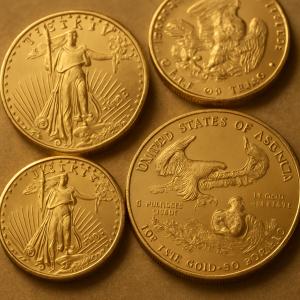
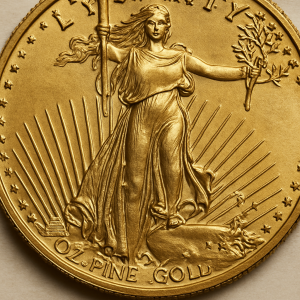
Holding a Gold Eagle coin in your hand reveals why many experts consider it the most beautiful American coin ever produced. The front of the piece, known in the minting world as the “obverse,” showcases the legendary Augustus Saint-Gaudens design originating in 1907. Lady Liberty strides forward confidently, carrying a lit torch to represent enlightenment and an olive branch to symbolize peace.
While that iconic front has remained completely unchanged, the back—or “reverse”—experienced a historic update in 2021. To modernize the artwork and introduce advanced anti-counterfeiting features, the U.S. Mint launched the “Type 2” design, replacing the original “Type 1” imagery. Whether you are inspecting newly minted bullion or evaluating older coins, spotting the difference is straightforward:

- Type 1 (1986–Mid 2021): Features a full family of eagles, showing a male flying above a nest with an olive branch for a waiting female and her hatchlings.
- Type 2 (Mid 2021–Present): Displays a striking, highly detailed close-up profile of a single bald eagle’s head with a piercing gaze.
Appreciating these distinct artistic eras helps you visually authenticate your tangible savings with confidence. Before purchasing either version, determining the optimal physical size for your financial goals is essential.
Why the 1 oz Weight is the Most Liquid Choice for Investors
When shopping for gold coins, the 1 oz Gold Eagle serves as the global benchmark. This size boasts the highest trading volume, meaning more people exchange it daily than any other weight. This popularity creates excellent “liquidity,” which simply means you can effortlessly convert your coin back into cash without hunting for a willing buyer.
That effortless exchange directly impacts your wallet through the “bid-ask spread.” Think of this as a dealer’s built-in transaction fee: the difference between their buying price (the bid) and selling price (the ask). Because one-ounce pieces are universally demanded, dealers take less risk stocking them, resulting in a much narrower spread. Liquidating physical gold assets in this standard size keeps more money in your pocket than trading smaller, less common weights.
Choosing the full-ounce option also saves you money on production costs. The U.S. Mint spends roughly the same labor to strike a tiny tenth-ounce piece as a full 1 oz Gold Eagle, making the manufacturing cost per ounce significantly cheaper for the larger size. This size efficiency dictates the actual checkout price, driven by the relationship between ‘spot price‘ and ‘premiums.
How ‘Spot Price’ and ‘Premiums’ Determine What You Actually Pay
When checking financial news for gold bullion, the number flashing on the screen is the spot price. This figure represents the current global market value for raw, unfabricated metal. If you melted down a one-ounce Gold Eagle, the raw gold left behind would equal this exact spot price, which dealers often call the coin’s “melt value.
Buying a finished coin, however, requires paying slightly more than that raw metal rate. Think of it like purchasing a loaf of bread: the spot price is the raw wheat, but the final retail price includes baking and packaging. This added cost, known as the premium, covers the U.S. Mint’s manufacturing expenses, safe distribution, and the local dealer’s necessary profit margin.
This structured pricing protects your savings when shopping. For a standard one-ounce American Gold Eagle, a reasonable premium typically ranges between four and eight percent above the current spot price. You can track these live market rates on major financial websites or smartphone apps before making a purchase, ensuring you never overpay for your physical savings.
Counterfeits are an unfortunate reality when dealing with high-value, universally demanded assets. Authentic U.S. Mint products possess unique physical characteristics making them exceptionally difficult to fake. You can quickly verify a coin using specific visual inspections and auditory tests.
Spotting a Real Eagle: Key Visual Marks and the “Ping Test”
Protecting your savings requires basic skills in fake gold detection. Because gold is exceptionally dense, counterfeiters cannot easily match both the size and weight of a genuine coin simultaneously. If a fake is the correct weight, it will usually be visibly too thick or wide. You can perform a reliable home check using a digital scale and calipers alongside this physical verification checklist:
- Weight: An American Eagle 1-ounce gold coin weighs exactly 1.0909 troy ounces (accounting for its durable 22k alloy).
- Dimensions: Must measure exactly 32.7 millimeters wide and 2.87 millimeters thick.
- Sound: Listen for a lingering acoustic resonance.
That final step, often called the “Ping Test,” relies on the metal’s unique vibrations. When gently balanced on a fingertip and tapped, genuine 22k gold produces a long, high-pitched, melodic ring. Conversely, base metals used in forgeries produce a dull clunk. The coin’s specific gravity—the unique density of its exact metal mixture—creates distinct sound waves that cheaper materials cannot replicate.
Although these basic home methods provide excellent confidence, authorized dealers offer non-destructive testing for absolute certainty. Professionals use a “Sigma” machine to measure electromagnetic resistance straight through the metal, verifying gold authenticity without ever scratching your coin. Once you confirm the asset is genuine, the coin’s presentation finish determines its final market category.
Why “Mint State” and “Proof” Coins Carry Different Price Tags
Purchasing a standard American Gold Eagle usually means buying a “Mint State” or uncirculated coin. These standard pieces are valued primarily for their metal weight, acting as a reliable, tangible store of wealth rather than a rare piece of art.
Conversely, specialized manufacturing transforms certain Eagles into highly sought-after collectible coins. Through a detailed process called proof striking, polished dies press the metal multiple times to create a stunning, mirror-like background. You can easily spot these premium versions through West Point Mint mintmark identification—just look for a small “W” stamped beneath the year. Because of their flawless finish and rarity, these pieces hold a higher numismatic value over their melt price, meaning they cost significantly more than their raw gold content alone.
Your choice between these options comes down to personal goals. Proof coins make spectacular gifts and heirlooms, while standard bullion provides the most physical gold for your dollar. Both versions remain strictly regulated government assets, eligible for inclusion in tax-advantaged retirement savings.
Using Gold Eagles for Your IRA: The IRS Requirements Explained
Securing a retirement nest egg usually involves stocks or bonds, but you can also hold physical assets to protect your savings. This requires a specialized account called a Self-Directed IRA (SDIRA). Unlike standard retirement plans, an SDIRA allows you to own tangible wealth while still enjoying the benefits of tax-deferred growth. Your investment grows without triggering taxes until you withdraw it during retirement.
Navigating precious metals IRA eligibility normally requires purchasing pure 24-karat bullion, but the IRS makes a famous “purity exception” for the Gold Eagle. Although this coin is minted in 22-karat gold, the U.S. government strictly guarantees its intrinsic weight and value. Because of this official backing, the IRS legally waives its standard purity rules, making this specific coin an incredibly popular choice for retirement accounts.
Keeping physical assets in an SDIRA comes with one strict rule: you cannot stash them in a home safe. The IRS mandates the use of a certified custodian, which acts as an official, highly secure vault that holds and tracks the metal on your behalf. Complying with this custodial storage requirement clears the way to safely purchase your first 1 oz American Eagle.
Where to Safely Buy Your First 1 oz Gold Eagle Without Getting Ripped Off
Entering the bullion market requires knowing how to spot and avoid common scams. While it might be tempting to hunt for bargains on eBay, buying from unknown online sellers often results in acquiring a counterfeit. Legitimate transactions always involve a “market spread”—a standard markup above the raw gold value that covers minting, distribution, and business costs. If a stranger offers a price below this baseline, it is a glaring red flag.
Most buyers weigh local coin shops against large online bullion giants. A neighborhood store lets you physically inspect a Gold Eagle coin in person and take it home immediately, though their prices are sometimes higher to cover retail rent. Major online retailers often offer better pricing due to lower overhead, but they require you to wait for secure, insured shipping.
The safest purchasing route involves sticking to the U.S. Mint’s “Authorized Purchasers” or officially established authorized gold dealers. These highly vetted businesses buy directly from the government. To guarantee dealer reputation before handing over your money, always verify these three criteria:
- A strong BBB rating: Look for a verified history of resolving customer complaints.
- A clear return policy: Reputable businesses will usually buy back what they sell to you.
- A verifiable physical address: Avoid companies operating solely out of P.O. boxes.
Storage Strategies: Home Safes vs. Bank Boxes vs. Professional Vaults
Holding your new investment creates a strong desire to keep it at home, but a standard locked drawer simply will not suffice. If you choose home storage, a heavy, fire-rated bolt-down safe is absolutely necessary to prevent burglaries. Additionally, standard homeowners’ policies severely cap payouts for precious metals, meaning you must purchase a specific insurance rider to fully cover your gold coins against theft or damage.
For buyers who prefer moving high-value items out of their house, bank safety deposit boxes seem like a logical step. The hidden catch is that banks do not insure box contents, leaving your assets vulnerable during a disaster. A better alternative involves utilizing secure storage in private vaults. These heavily fortified, third-party facilities are designed specifically for precious metals and fully insure your exact holdings.
When choosing professional depositories, always request segregated storage instead of standard allocated accounts. This means your specific assets are kept in a separate, clearly labeled container rather than being mixed into a communal pile of gold. Once physical security is established, planning for the future requires navigating the tax implications of eventually selling the gold.
Tax Implications: What Happens When You Decide to Sell Your Gold?
Turning your investment back into cash brings inevitable questions about the IRS. When liquidating physical gold assets at a profit, the government classifies your coins as “collectibles” rather than standard stocks. Selling within a year taxes that profit as ordinary income. However, holding your coins longer triggers a long-term capital gains tax capped at 28%, calculated purely on the profit made above your original purchase price.
Beyond calculating your own profits, navigating the tax implications of selling bullion involves specific dealer reporting rules. For exceptionally large transactions—such as selling 25 one-ounce coins simultaneously—federal law requires the purchasing dealer to file a Form 1099-B. This paperwork automatically alerts the IRS to the sale. While smaller liquidations typically avoid this automatic dealer reporting, you are legally required to declare financial gains on your personal return.
Meticulous record-keeping remains your best defense against overpaying during tax season. Even though American Eagles function as legal gold currency, the IRS treats them as property, meaning your original receipts prove your exact starting cost. Managing these financial thresholds effectively often influences purchasing habits, making fractional weights an attractive alternative to full ounces.
The Role of Fractional Weights: Why Some Buy 1/4 oz or 1/10 oz Instead
While a full Gold Eagle coin requires a significant investment, the U.S. Mint produces smaller fractional weight denominations to fit everyday budgets. These sizes allow you to steadily build wealth by buying smaller amounts over time—a simple strategy called dollar-cost averaging. They also make highly memorable physical gifts for milestone events like graduations or weddings.
Buying smaller pieces means paying a higher “premium.” Much like buying travel-sized shampoo, you pay more per ounce for smaller packaging. Consequently, 1/10-ounce pieces are the most expensive way to buy gold. Notice how the “cost per ounce” premium steadily increases across the different sizes:
- 1 oz coin: Lowest premium (best value per ounce)
- 1/2 oz coin: Slightly higher premium
- 1/4 oz coin: Noticeably higher premium
- 1/10 oz coin: Highest premium (least cost-effective per ounce)
Balancing these extra costs against your savings goals dictates your personal strategy, particularly when tracking the American Eagle’s market trajectory into 2026 and beyond.
Tracking the American Eagle 1 Ounce Gold Coin Future into 2026

Looking ahead to the American Eagle 1-ounce gold coin’s future in 2026, the market holds exciting possibilities because it marks America’s Semiquincentennial—our 250th anniversary. While the beautiful Type 2 design is here to stay, major historical milestones often prompt unique variations from the U.S. Mint that attract massive public interest.
Supply directly impacts value during these celebration years. The government carefully controls “mintage figures,” which is the total number of coins manufactured annually. If the Mint caps production of the 2026 Gold Eagle coin, that lower mintage creates instant rarity for anyone wanting a physical piece of history.
Beyond the coin itself, authorized dealers will likely offer graded versions featuring “special labels” that highlight this historic pedigree directly on protective cases. Whether you want to chase rare anniversary editions or stick to buying standard years for reliable metal weight, having a clear strategy is essential.
Building Your Legacy: A Step-by-Step Plan to Owning Physical Gold
You started this journey wondering why a coin with “$50” stamped on the back costs thousands of dollars. Now, the vital difference between a coin’s face value and its actual intrinsic value is clear. The world of precious metals is not an exclusive club reserved for financial experts; it is a practical, tangible avenue for personal savings.
Stepping into the physical precious metals market requires focus. Your primary goal is simply to establish a secure, long-term store of value that you can safely hold.
Transforming this knowledge into a physical piece of gold currency requires just a few deliberate actions:
- Research: Check the daily spot price to establish the current baseline value of the metal.
- Budget: Create a personal gold-buying budget that comfortably accounts for both the spot price and the dealer’s premium.
- Dealer Selection: Identify authorized, reputable sellers rather than relying on unverified online auctions.
- Purchase: Execute your order smoothly, knowing exactly what you are paying for and why.
- Secure: Choose the right storage method before the coin arrives, whether that is a hidden home safe or a bank deposit box.
When you finally hold that beautifully crafted coin in your hand, it represents much more than a simple financial transaction. You can feel confident in the lasting value of a 1 oz Gold Eagle, knowing you hold a piece of American history and a globally recognized standard of purity. Start with a well-researched purchase, and enjoy the peace of mind that comes from owning a beautifully real, tangible asset.
Q&A
Question: Why does a 1 oz American Gold Eagle with a $50 face value cost thousands of dollars?
Short answer: The $50 is its legal-tender face value, but the market prices the coin by its metal. Dealers ignore the face value and charge based on intrinsic value—the global spot price of the gold inside—plus a small premium for minting and distribution. Some editions can also carry numismatic (collector) value. The legal-tender status still matters: it adds federal anti-counterfeiting protections and helps with transport across borders, but it doesn’t determine the investment price.
Question: If the coin is 22-karat, am I getting less than a full ounce of pure gold?
Short answer: No. Each 1 oz Gold Eagle contains a full troy ounce of pure gold, guaranteed by the U.S. government. To make the coin tougher for handling, the Mint adds small amounts of silver and copper on top of that gold, bringing the total coin weight to 1.0909 troy ounces. This “Crown Gold” alloy (22k) resists wear better than 24k coins like the Gold Buffalo, which scuff more easily.
Question: How is the price I pay determined, and why is the 1 oz size the most cost-effective and liquid?
Short answer: Pricing = spot price (the live market value of raw gold) + a premium that covers minting, secure distribution, and dealer costs. For standard 1 oz Eagles, a typical premium is about 4–8% above spot. The 1 oz coin is the global benchmark: it trades in the highest volume, so dealers take less risk and usually offer tighter bid-ask spreads. It’s also cheaper per ounce to produce than smaller fractions, making the full-ounce coin both easier to resell and better value per ounce.
Question: How can I verify that a Gold Eagle is genuine?
Short answer: Use simple at-home checks, then professional confirmation if needed:
- Weight: 1.0909 troy ounces (22k alloy total weight)
- Dimensions: 32.7 mm diameter, 2.87 mm thickness
- Sound: A clear, lingering “ping” when lightly tapped (fakes sound dull)
- Design: Saint-Gaudens Lady Liberty on the obverse; reverse is either Type 1 (1986–mid-2021, eagle family) or Type 2 (mid-2021–present, close-up eagle head). Professionals can verify non-destructively with a Sigma machine (electromagnetic testing). Reduce risk by buying from U.S. Mint Authorized Purchasers or established dealers with a strong BBB rating, a clear return/buyback policy, and a verifiable physical address—avoid “too-good-to-be-true” online bargains.
Question: Can I hold American Gold Eagles in an IRA, and how must they be stored?
Short answer: Yes. Through a Self-Directed IRA (SDIRA), Gold Eagles are IRA-eligible thanks to an IRS “purity exception” recognizing the U.S. government’s guarantee, even though the coin is 22k. The IRS requires you to use a qualified custodian/depository—you cannot store IRA metals at home. This setup allows tax-deferred growth while keeping the assets securely vaulted and properly tracked.