Size of Gold Bar: Dimensions, Weights, and Standards Every Buyer Should Know
When someone asks me about the size of gold bar they should buy, my first answer is always the same: it depends on what you’re trying to do with it. A jeweler in Dubai, a sovereign wealth fund in Zurich, and a private investor in Texas all want different things, and the metal sizes itself accordingly.
At Minerals Base Agency, we’ve been moving gold out of Uganda’s mining regions and into refineries across Europe, the Middle East, and Asia for years now. We see every bar size you can name pass through our hands, from gram-sized wafers up to the heavy cast bricks that need two people to lift safely. This guide pulls together what we’ve learned, so you walk into your next purchase knowing exactly what you’re holding.
Quick takeaway: The “standard” gold bar most people picture, the one stacked in central bank vaults, weighs 400 troy ounces (about 12.4 kg) and measures roughly 7 × 3 ⅝ × 1 ¾ inches. But that’s only one of more than a dozen common formats traded today.
Why the Size of a Gold Bar Actually Matters
Gold’s value comes from its weight and purity, not its shape. So why fuss over dimensions at all? A few practical reasons:
- Storage. A 1 kg bar fits in a small safe-deposit box; a 400 oz bar does not.
- Liquidity. Smaller bars are easier to sell piece by piece. Bigger bars carry lower premiums but you have to move the whole thing at once.
- Authentication. Every reputable refinery, from PAMP Suisse to Valcambi to the Perth Mint, casts bars to specific tolerances. If a bar’s size is off, that’s a red flag before you’ve even tested the metal.
- Shipping and insurance. Customs declarations, vault fees, and freight quotes are all driven by physical dimensions, not just weight.
Knowing the gold bar dimensions you’re dealing with isn’t trivia. It’s part of doing your homework.
The Standard Size of a Gold Bar (the “Good Delivery” Bar)
The closest thing the industry has to a global benchmark is the London Good Delivery bar, governed by the LBMA (London Bullion Market Association). This is the bar central banks hold and the one you’ll see in heist movies.
Specs for the standard Good Delivery gold bar:
| Specification | Measurement |
|---|---|
| Weight | 350–430 troy oz (target ~400 oz / 12.4 kg) |
| Length | 250 mm (~7 inches) |
| Width | 70–85 mm (~3 ⅝ inches at top) |
| Height | 35–45 mm (~1 ¾ inches) |
| Minimum purity | 99.5% (995 fineness) |
| Shape | Trapezoidal (slightly tapered) |
Two things surprise first-time buyers here. First, the weight isn’t fixed exactly at 400 oz — there’s a tolerance range, which is why every bar gets individually weighed and stamped. Second, the bar is trapezoidal, not a perfect rectangle. That taper makes it easier to lift out of a vault rack.
Most retail investors will never own a Good Delivery bar. At today’s gold price, you’re looking at well over US $1.2 million per bar. Which brings us to the sizes most people actually buy.
Common Gold Bar Weights and Dimensions
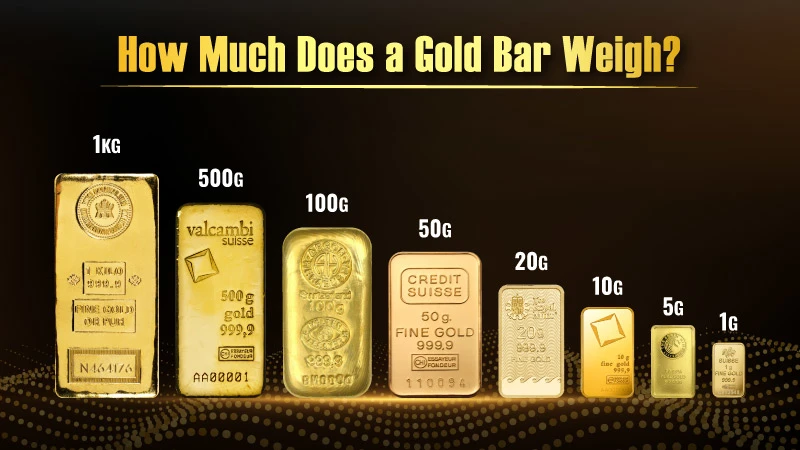
Here’s the full range of gold bar sizes you’ll encounter in the wholesale and retail market. Dimensions vary slightly by mint, but these numbers are accurate within a millimetre or two for major refineries.
| Weight | Approx. Length × Width | Typical Use |
|---|---|---|
| 1 gram | 8.6 × 15.5 mm | Gift bars, entry-level investors |
| 2.5 grams | 13.9 × 22.2 mm | Small accumulators |
| 5 grams | 15 × 24 mm | Retail bullion |
| 10 grams | 17.8 × 31.1 mm | Popular in US, EU, Middle East |
| 1 tola (11.66 g) | 25.4 × 10 × 1.5 mm | South Asian markets |
| 20 grams | 22 × 38.6 mm | Mid-tier retail |
| 50 grams | 27.5 × 42.5 mm | Common gift / investment |
| 100 grams | 34 × 50 mm | High-volume retail bar |
| 250 grams | ~50 × 80 mm | Wholesale |
| 500 grams | ~55 × 90 mm | Wholesale |
| 1 kilogram | ~40 × 80 × 18 mm (cast) or 80 × 116 × 9 mm (minted) | Investor / dealer standard |
| 10 troy oz | ~82 × 40 × 8 mm | US bullion staple |
| 100 troy oz | ~185 × 100 × 29 mm | Institutional |
| 400 troy oz | ~250 × 80 × 40 mm | Central banks, LBMA |
A note on cast vs. minted bars, since this trips people up: cast bars are poured into a mould and have rougher edges, often with character marks and slightly imprecise dimensions. Minted bars are cut from a rolled sheet, sharply finished, and usually sealed in a tamper-proof assay card. Both contain the same gold. Cast tends to be cheaper per gram; minted is prettier and easier to verify visually.
Gold Bar Sizes Most Common in the United States
US investors lean toward a narrower set of sizes than the global market. The four formats that dominate American vaults and IRAs:
1 troy ounce bar — Roughly 41 × 24 × 2 mm. The workhorse of US retail bullion. Easy to store, easy to liquidate, but carries the highest premium per gram because of fabrication cost.
10 troy ounce bar — Around 82 × 40 × 8 mm. The sweet spot for many private investors. Premium drops noticeably compared to 1 oz, and the bar still fits comfortably in most home safes.
1 kilogram bar (32.15 troy oz) — Approximately 80 × 40 × 18 mm in cast form. Popular with serious accumulators and dealers. Substantially lower premium per ounce than smaller sizes.
100 troy ounce bar — About 185 × 100 × 29 mm. The largest size most non-institutional buyers will own. You’ll see these traded on the COMEX exchange.
If you’re buying for a Gold IRA in the US, the IRS requires bars to be at least 99.5% pure and produced by an approved refiner. Size doesn’t disqualify you, but the bar’s certification does.
How Minerals Base Agency Supplies Gold Bars from Uganda
Uganda sits in one of Africa’s richer gold corridors. Karamoja, Busia, Mubende, and Buhweju all produce gold that ends up refined and bar-stamped for export. Minerals Base Agency is one of the established names in that supply chain.
What we do, in plain terms:
- Source doré gold from licensed Ugandan small-scale and artisanal miners.
- Refine it through partner refineries to investment-grade purity (96–99.99%).
- Cast bars in the sizes our buyers actually request, from 100 g up to kilo bars and beyond.
- Export to refineries and dealers in Dubai, Switzerland, India, China, and increasingly the US, with full documentation, assay certificates, and customs clearance handled in Kampala.
A buyer in Singapore who needs ten 1 kg bars next month gets a different package than a refinery in Belgium ordering doré in bulk. We size the deal to your end use. If you want to talk specifics — gold bar weight, fineness, delivery timeline, payment terms that’s a conversation, not a checkout button. Reach out through our contact page and we’ll walk you through it.
Choosing the Right Gold Bar Size for Your Goals
A few rules of thumb we share with new buyers:
If you’re starting small and want flexibility, stick with 10 g, 1 oz, or 50 g bars. You’ll pay a higher premium per gram, but you can sell a portion without breaking a larger bar.
If you’re building a serious position, kilo bars and 100 oz bars give you the best price per gram and are still recognisable enough to liquidate through any major dealer.
If you’re an institution or industrial buyer, Good Delivery 400 oz bars or doré shipments straight from the source are where the conversation starts.
If you’re storing at home, be honest about your safe’s capacity and weight rating before you buy a 100 oz brick. Banks and private vaults exist for a reason.
For more on the price of a gold bar, purity standards, and our 1 kg gold bar offering, follow those links — they pair naturally with this guide.
Frequently Asked Questions About the Size of Gold Bars
What is the standard size of a gold bar? The international standard is the LBMA Good Delivery bar at roughly 400 troy ounces (12.4 kg), measuring about 7 × 3 ⅝ × 1 ¾ inches. For retail buyers, the “standard” is more often a 1 kg or 1 oz bar, since those are the sizes most dealers actually stock.
How big is a 1 kg gold bar? A cast 1 kg bar is around 80 × 40 × 18 mm. A minted 1 kg bar is flatter and longer, closer to 116 × 80 × 9 mm. Both weigh exactly 32.15 troy ounces.
Are all gold bars the same shape? No. Cast bars are usually thicker and rougher; minted bars are flat, sharp-edged, and often sealed in assay cards. Good Delivery bars are trapezoidal. Tola bars (South Asia) are thin and rectangular.
Why do small gold bars cost more per gram than big ones? Fabrication cost. Stamping a 1 g wafer takes nearly the same labour as stamping a 100 g bar, but you spread that cost over far less metal. This is why larger bars almost always have the lowest premium over the spot price.
Does Minerals Base Agency sell gold bars internationally? Yes. We export refined gold bars from Uganda to verified buyers across Asia, Europe, the Middle East, and North America, with full export documentation and assay certification. Contact us through our contact page to discuss volume, size, and delivery options.
Can I buy a 400 oz gold bar? Technically yes, but you need to be a qualified institutional or high-net-worth buyer. Most refineries won’t release Good Delivery bars to retail clients because of the trade-volume requirements built into LBMA rules.
Talk to Minerals Base Agency
If you’re done reading and ready to discuss a real purchase — whatever size of gold bar you need — we’re based in Kampala and respond to enquiries the same business day. Email, WhatsApp, or the contact form on our site all reach the same desk.
Minerals Base Agency — Uganda’s trusted gold seller and exporter. 👉 Get a quote