Current Trends in American Gold Eagle Prices
The price of an American Gold Eagle moves every minute the markets are open. For most buyers, this daily price is more than just a number on a chart; it is a reflection of what the world thinks our money is worth today. Buyers checking the daily American Gold Eagle price might expect a simple, straightforward number to appear on their screen. In reality, buying physical gold involves navigating two completely different sets of numbers.
Imagine watching the evening news announce that gold just hit $2,000 an ounce, only to find online dealers charging $2,150 for a one-ounce coin. This $150 gap frustrates countless first-time buyers who assume they are being overcharged. According to industry data from major bullion exchanges, this price difference is completely normal and represents the fundamental divide between paper trading and physical ownership.
The precious metals market operates much like a local grocery store. The “spot price”—the current gold price scrolling across financial television channels—is essentially the wholesale farm price. It represents the raw, unshaped metal sitting in a massive commercial vault. You cannot buy that raw commodity at that exact price, just as you cannot buy a single apple at the bulk orchard rate.
What you actually pay at checkout includes a retail premium. This acts as a convenience and manufacturing fee added to the base gold market price. It covers the costs of the United States Mint transforming raw material into a beautiful, secure coin, alongside shipping, insurance, and the dealer’s profit. In practice, a fair premium for a one-ounce gold coin usually sits somewhere between five and eight percent above that wholesale baseline.
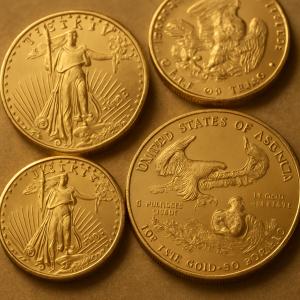
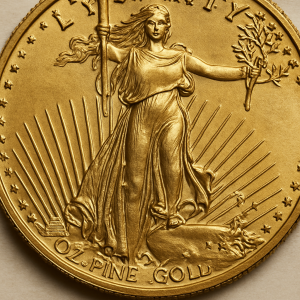
Because it is guaranteed by the U.S. government for exact weight and purity, this specific coin remains the ultimate benchmark for American savers. Recognizing how these two numbers interact separates casual browsers from informed buyers. Once you identify exactly where your money is going, spotting a genuinely good deal on a trusted physical asset becomes second nature.
The ‘Melt Value’ Math: What is Your Coin Actually Worth?
Holding a one-ounce American Gold Eagle reveals a surprising physical truth: it weighs a bit more than the standard ounce you see on a kitchen scale. The precious metals market relies on a specialized measurement called a “Troy Ounce” (ozt), which is roughly ten percent heavier than a regular grocery ounce.
Because pure gold is famously soft, a coin made entirely of unmixed gold can easily scratch, dent, or bend from basic handling. To solve this problem, the U.S. Mint crafts the Eagle from 22-karat gold, thoughtfully blending in small amounts of silver and copper to give the coin lasting durability.
Despite these added metals making the physical coin heavier overall, the government guarantees that every piece contains exactly one full troy ounce of pure gold. This strict standard removes any guesswork regarding the purity and gold content of American Eagles. You can look at the daily wholesale market to know the exact baseline worth of your coin.
This baseline math seamlessly evaluates the current spot price vs bullion melt value; a coin’s melt value is simply the spot price of that single pure ounce inside. This physical composition directly connects your asset to broader financial forces, specifically how COMEX futures dictate daily coin costs.

Why COMEX Futures Dictate Your Daily Coin Cost
When checking the daily price of an American Eagle, you are actually looking at a number generated by a massive electronic marketplace in New York called the COMEX. Investors there buy and sell “futures contracts,” which are legal agreements to purchase gold at a specific price on a future date.
This high-speed exchange trades millions of ounces in “paper gold”—digital promises rather than physical bars—creating the direct impact of COMEX futures on physical gold prices. Because moving digital contracts is instantly effortless compared to shipping heavy metal, this paper market sets the global baseline that dictates what you will ultimately pay in reality.
Timing plays a massive role among the factors influencing daily gold coin market fluctuations. The most intense price swings usually hit between 8:00 AM and 10:30 AM Eastern Time, which is exactly when major economic reports are released and New York traders rapidly react to global overnight events.
Even though the digital ticker bounces around all morning, your local coin shop’s prices do not drop quite as fast. Retailers buy their physical inventory at fixed costs, meaning they naturally resist lowering retail prices the minute the paper market dips. Shop owners hold their ground because of how the asset travels up the supply chain to their display cases.
The Authorized Purchaser Chain: Where Your Coin Comes From
To find the most competitive pricing, your first instinct might be to cut out the middleman and buy directly from the government. However, the U.S. Mint does not sell bullion coins to the public. Instead, they rely on exclusive wholesalers called Authorized Purchasers (APs). These institutions buy massive quantities, allowing the Mint to focus purely on manufacturing rather than retail logistics.
Tracing the official US Mint authorized purchaser markup prevents overpaying. The physical coin travels through a strict three-tier distribution chain:
- U.S. Mint: Produces the coin, selling it in bulk for the spot price plus a fixed manufacturing fee.
- Authorized Purchaser: Buys pallets of gold, adding a wholesale markup before distributing it to the broader market.
- Retail Dealer: Purchases inventory from the AP, adding a final retail premium to cover store overhead and profit.
This chain explains why smaller local shops often charge more than giant online dealers, since independent stores lack the buying power to secure deep wholesale discounts. Every hand that touches the gold naturally adds a fraction to your final cost. Beyond the supply chain, the physical size of the metal drastically shifts the price. A full one-ounce coin costs less per ounce than a fractional piece.
Decoding the Premium: Why 1oz Costs Less Per Ounce than 1/10oz
When evaluating retail prices, a common assumption is that a tenth-ounce coin costs exactly one-tenth of a full one-ounce version. However, the precious metals market operates much like buying in bulk at a warehouse club. When purchasing smaller, “fractional” gold coins, you pay a higher percentage above the actual raw gold value. This extra cost is the premium, and it drastically scales up as the coin gets smaller.
The price difference comes down to basic manufacturing. It takes the U.S. Mint roughly the same amount of labor, machinery, and packaging to produce a tiny 1/10oz coin as it does to stamp a heavy 1oz coin. To cover those fixed production costs, dealers must charge a larger markup on the smaller pieces. Buying ten 1/10oz coins to make a full ounce costs significantly more than buying a single 1oz coin.
Despite the steeper markup, smaller coins offer distinct practical benefits. The liquidity of fractional gold eagle weights makes them incredibly easy to sell or trade if you only need a small amount of cash on short notice. Furthermore, they allow savers to build their physical wealth gradually without needing thousands of dollars upfront. The extra premium pays for financial flexibility.
Balancing that upfront premium against a personal budget is the secret to buying gold effectively. Historically, these iconic coins have weathered major economic storms with distinct resilience.
Historical Performance: How Gold Eagles Weather Economic Storms
Since its 1986 debut, the U.S. dollar has continually lost buying ability. This invisible theft is a decline in “purchasing power” caused by inflation. Gold acts as a financial anchor against this loss. While paper currency weakens, a physical ounce of gold historically maintains its ability to buy the exact same amount of goods.
Tracking the gold market price reveals that these coins are not get-rich-quick schemes. Their true superpower is wealth preservation. When economic storms hit—like a financial crisis or spiking inflation—savers naturally flock to physical gold as a safe harbor, driving up its value when cash feels risky.
The historical American Gold Eagle performance highlights steady resilience rather than lottery-ticket gains. Average annualized returns for gold show a clear pattern:
- 3-Year Snapshot: Averages roughly 5% to 8%, often surging during sudden market fear.
- 5-Year Snapshot: Yields about 6% to 9%, easily smoothing out short-term volatility.
- 10-Year Snapshot: Consistently hovers around 5% to 7%, comfortably outpacing standard bank savings accounts.
This reliable track record proves why smart buyers hold precious metals for decades, not days. With long-term protection established, buyers face a choice between Proof and Uncirculated versions.
Proof vs. Uncirculated: Which Version Fits Your Strategy?
The daily market features two very different price tags for the exact same ounce of metal. This gap exists because the U.S. Mint produces two distinct versions: one for practical savers and another for dedicated collectors.
For buyers wanting to protect their wealth, the standard “Uncirculated” bullion version is the smartest choice. These coins are manufactured strictly for their raw gold content, meaning their cost directly tracks the daily market price plus a standard premium. Because they are priced on weight, standard eagles are easily resold to any dealer for a highly predictable payout.
“Proof” versions demand a much higher cost due to specialized manufacturing. Mints strike these coins multiple times with polished dies, creating a stunning, reflective mirror-finish. This extra labor transforms the coin into a collectible—a concept known as “numismatics,” where value relies on beauty and scarcity rather than just the metal itself. Evaluating the proof vs uncirculated gold eagle value prevents accidentally overpaying for a collector’s item when seeking a financial anchor.
Your strategy dictates your choice: invest in predictably priced gold weight or bet on the collectible market. Securing the preferred style requires ensuring the physical coin is genuine.

Spotting the Fake: Three Tests to Protect Your Investment
Finding a bargain feels great, but an unusually low price is a primary warning sign. If a seller offers a coin significantly below the spot market value, walk away immediately. Scammers use cheaper metals to trick eager buyers, but protecting your wallet does not require a laboratory. Successfully identifying counterfeit gold bullion coins relies on basic physical principles.
The secret to catching fakes lies in the unique density of gold. Counterfeiters face a physical puzzle: they cannot perfectly match both the official weight and size using cheaper metals. If a fake uses lighter materials, it must be noticeably thicker or wider to weigh enough. If scammers match the dimensions exactly, the coin will feel noticeably light.
To verify a purchase, rely on these three practical checks:
- Caliper and Scale Check: Weigh the coin, then measure its diameter and thickness to ensure it perfectly matches official U.S. Mint specifications.
- The Magnet Test: Gold is strictly non-magnetic. If your coin reacts to a strong rare-earth magnet, it contains hidden steel or iron.
- The Ping Test: Gently tap the coin with another piece of metal. Genuine gold produces a long, high-pitched ringing sound, whereas lead makes a dull clunk.
While the Eagle’s specific alloy makes it durable and easy to authenticate, other nations manufacture their bullion differently.
Eagle vs. Maple Leaf: Choosing the Right Sovereign Coin
Weighing the American Gold Eagle vs Canadian Maple Leaf usually comes down to handling preferences. The Canadian coin features 24-karat pure gold, making it brilliantly yellow but easily scratched. The American version uses a rugged 22-karat alloy, mixing trace metals for durability without sacrificing its guaranteed one-ounce gold content.
- Purity: Eagles are durable 22k; Maple Leafs are soft 24k.
- IRA Eligibility: Both perfectly qualify for retirement accounts.
- US Recognizability: Eagles are the undisputed domestic favorite.
Local market dynamics matter when maximizing resale value. Because the Eagle is instantly recognized by neighborhood shops and major exchanges alike, American dealers typically pay higher premiums to buy them back. They know Eagles resell immediately, whereas foreign coins might sit longer in display cases.
Behind the scenes, IRS rules play a surprising role. Dealers must file a 1099-B tax form if you sell 25 or more one-ounce Maple Leafs at once, since foreign 24k coins trigger specific tracking thresholds. Gold Eagles are entirely exempt from this bulk-reporting mandate, offering extra financial privacy. Timing the purchase requires knowing when the market breathes.
Timing Your Purchase: When Does the Market Breathe?
Watching the gold market resembles watching gas prices fluctuate. While global exchanges trade around the clock, the best time to buy gold bullion coins typically falls during specific volatility windows. Predictable periods, usually when major trading hubs like the New York COMEX open each morning, see active futures trading create temporary price dips that everyday buyers can capture.
Avoid rushing to checkout during a major news event. When sudden inflation reports or geopolitical headlines hit, anxious buyers flood dealers with urgent orders, causing immediate panic spikes. During these frenzied hours, dealers often widen their premiums, meaning you pay significantly more just to participate that day.
Instead of reacting to breaking headlines, smart buyers use live tracking tools to monitor for natural dips on quiet afternoons. Setting an automated phone alert lets the market come to you, ensuring a fair baseline cost without emotional markups. Securing a coin at a comfortable price point naturally leads to tax considerations upon selling.
Tax Implications: What You Owe When You Sell
Holding physical wealth feels different from owning shares on a screen, but the IRS treats both as taxable assets. The most important number regarding the tax implications of investing in gold bullion is your “cost basis.” Your cost basis is exactly what you originally paid, including the dealer’s premium. If you buy an American Gold Eagle for $2,000 and eventually sell it for $2,500, your taxable profit is just that $500 difference, not the total sale amount.
The government categorizes precious metals uniquely. The IRS taxes physical gold at a “collectibles tax rate,” capping long-term capital gains at a maximum of 28 percent rather than standard stock rates. While dealers are legally required to report massive, bulk bullion transactions directly to the government, you are personally responsible for reporting standard individual profits on your annual tax return. Keeping original receipts proves your exact cost basis and prevents overpaying.
Balancing these regulations with a smart exit strategy protects the final payout.
Where to Sell for the Highest Return
When the time comes to cash in, knowing where to sell gold coins for highest return is critical. The spot price acts as the baseline wholesale value. However, dealers offer a “buy-back price,” which is the precise amount they will pay you today. This quote is always slightly lower than what they charge customers buying that same coin.
This gap between a dealer’s buying and selling price is called “the spread.” The dealership leaves room to cover overhead and make a profit. To minimize the loss hidden in this spread, look beyond the first quote. A buyer’s reputation for transparent pricing matters far more than flashy ads promising top dollar.
Before handing over physical wealth, use this checklist to protect your payout:
- Check the current gold price: Knowing today’s spot value exposes lowball offers immediately.
- Call three dealers: Compare quotes from local shops and online retailers to find the narrowest spread.
- Verify shipping insurance: If mailing your coin, confirm their transit policy fully covers your asset.
Securing a fair deal maximizes your final profit while keeping your hard-earned value safe. Gracefully exiting the market requires the same careful planning as entering it.
Your Action Plan for Tracking and Buying American Gold Eagles
Navigating the precious metals market requires separating the wholesale baseline from the dealer’s convenience fee. Reading the market eliminates guesswork, allowing you to identify fair pricing based on actual wholesale values rather than retail markups.
Executing a confident purchase relies on paying a reasonable premium for a physical product without getting overcharged. Build a resilient portfolio one ounce at a time using this straightforward 4-step checklist:
- 1. Check Spot: Look up the raw wholesale gold price immediately before shopping.
- 2. Compare 3 Dealers: Check prices across multiple sellers to find the most competitive premium.
- 3. Verify Weight/Purity: Ensure you are looking at a 1-ounce, 22-karat U.S. Mint coin.
- 4. Secure Storage: Decide on a home safe or bank lockbox before bringing the metal home.
Once your coin is safely stored, using reliable tracking tools allows you to monitor how purchasing power holds up against everyday inflation. Independent evaluation replaces reliance on financial commentators, equipping you with the skills to assess tangible assets directly. Securing physical assets anchors savings in something historically secure, and making informed decisions provides the peace of mind that comes from holding real value.
Q&A
Question: Why is the price I see for a 1 oz American Gold Eagle higher than the spot price on TV?
Short answer: Because you’re buying a finished retail product, not wholesale raw metal. The spot price is the wholesale “farm price” for unshaped gold traded on exchanges. A real coin carries a retail premium that covers U.S. Mint manufacturing, shipping, insurance, and dealer profit. That premium for a 1 oz Eagle commonly runs about 5%–8% over spot. On top of that, the coin moves through a three-tier chain—U.S. Mint (spot + mint fee) → Authorized Purchaser (adds wholesale markup) → Retail dealer (adds retail premium). Each step adds a bit to the final sticker, which is why dealers might list $2,150 when spot reads $2,000.
Question: If an American Gold Eagle is 22k and heavier than a standard ounce, what’s its actual melt value?
Short answer: Its melt value equals the spot price of exactly one troy ounce of pure gold—no more, no less. Eagles are struck in a durable 22k alloy (gold blended with small amounts of silver and copper), so the coin’s total weight is higher than one troy ounce. But the U.S. Mint guarantees each 1 oz Eagle contains exactly 1.000 troy ounce (ozt) of pure gold. Since a troy ounce is about 10% heavier than a regular grocery (avoirdupois) ounce, the coin’s gross weight can surprise first-timers. For pricing, ignore the extra alloy: the coin’s melt value is simply today’s spot price for one troy ounce, which is set by the wholesale market.
Question: How do COMEX futures affect what I pay for a coin, and why don’t local dealers cut prices the instant gold dips?
Short answer: COMEX, a major New York futures exchange, sets the global baseline for gold via high-speed trading of “paper” contracts. Because digital contracts move instantly while physical metal doesn’t, futures prices become the reference point for physical coin pricing. Volatility tends to peak around 8:00–10:30 AM Eastern when key economic data hits. Retail coin prices, however, don’t move tick-for-tick: dealers carry inventory bought at fixed costs and won’t slash prices the moment paper markets dip. That lag reflects real-world supply chains and the cost basis of the coins already in their cases.
Question: Should I buy a 1 oz Eagle or fractional sizes like 1/10 oz?
Short answer: If you want the lowest cost per ounce, buy the 1 oz coin; if you want flexibility, fractionals can be worth the higher premium. Minting a tiny coin costs nearly as much in labor and machinery as minting a large one, so smaller coins carry a higher percentage premium above melt value. Ten 1/10 oz coins usually cost more than one 1 oz coin with the same total gold. The trade-off: fractionals are easier to sell in small amounts and let you build a position gradually without committing thousands of dollars at once.
Question: What’s the difference between Proof and Uncirculated Gold Eagles, and which fits a saver’s strategy?
Short answer: Uncirculated (bullion) Eagles are designed for wealth preservation and track spot plus a standard premium; they’re easy to resell at predictable prices. Proof Eagles are collector coins, struck multiple times with polished dies for a mirror finish. Their higher price reflects numismatic appeal—beauty, scarcity, and collector demand—rather than just metal content. If your goal is a predictable hedge against inflation, Uncirculated is typically the better fit. Choose Proofs only if you intentionally want to pay for collectible value on top of the gold.