Gold Piece
Handing a modern twenty-dollar bill to a shopkeeper in Ancient Rome would earn you nothing but a confused stare. But drop a nineteenth-century gold coin on that same counter, and you would immediately be recognized as a wealthy patron. Gold is the only “language” of money that has never needed a translator, acting as a universal standard of wealth across civilizations. Even though the faces of emperors and eagles stamped on the surface have changed, the intrinsic value of the metal itself has survived the collapse of countless empires.
Why did humanity universally settle on this specific yellow metal rather than iron, copper, or silver? According to chemists and historical researchers, gold possesses a unique “Goldilocks” property that makes it the perfect physical money. It is rare enough to be highly valuable, yet common enough to actually find and use. More importantly, it does not rust or tarnish like iron, and it melts at a temperature that ancient civilizations could manage, making the history of gold a story of perfect natural chemistry.
Carrying chunks of this perfect metal through ancient markets, however, created a massive logistical headache. Before the invention of standardized money, merchants and buyers had to painstakingly weigh raw nuggets and dust for every single transaction to ensure they weren’t being cheated. Imagine trying to buy a week’s groceries with a solid brick of bullion; you would need a chisel and a highly accurate scale just to make change. Commerce desperately needed a way to package this wealth into manageable, universally trusted units.
That everyday friction sparked early gold piece history, transforming raw nature into minted authority. By stamping a specific weight of metal with a king’s seal, rulers provided a guarantee that eliminated the need for merchant scales, forever changing the evolution of gold coinage systems. This ingenious leap introduced a fascinating tension between a coin’s “face value”—the worth declared by the ruler—and its intrinsic value as raw metal. It was this very innovation that kicked off a sweeping, 2,700-year journey from ancient Lydian pockets to modern bank vaults.
Summary
This article traces how gold’s unique physical properties made it the world’s most trusted money and how minting transformed raw metal into standardized, reliable coins. From the Lydian lion and Roman aureus to the Byzantine solidus, Florin/Ducat, Spanish doubloon, and the U.S. Double Eagle, gold financed empires, global trade, and the rise of banking—while debasement and inflation repeatedly tested trust. Advances in design, alloy “recipes,” and legal assays safeguarded durability and purity, and the shift from coinage to the gold standard and then fiat reshaped money’s foundations. Today, value hinges on bullion versus numismatic rarity, counterfeits can be screened with simple tests, and physical gold remains a durable store of value in a digital age.

From Nuggets to Lions: How the Lydian Lion Invented ‘Trust’ in Your Pocket
Imagine buying bread by weighing a metallic chunk on a scale rather than handing over a simple dollar. That was early trade. Merchants initially used electrum, a natural riverbank mix of gold and silver. Because the metal ratio in these ancient Lydian electrum coins varied wildly, transactions were always gambles. To end this chaos in the 6th Century BC, the Kingdom of Lydia separated the metals, standardized the purity, and stamped their new currency with a roaring lion.
Producing this first true coin required sheer physical force. Royal workshops followed three intense steps:
- Heating: Weighed pellets of pure gold were fired until glowing and soft.
- Placing: The hot pellet was carefully set onto an engraved bronze anvil.
- Striking: A worker swung a heavy hammer, forcing the soft metal into the die.
For providing this trusted weight, the King kept a small fraction of the gold. This royal fee, called seigniorage, meant stamped coins were universally accepted and practically more valuable than unverified lumps. That roaring lion changed gold piece history forever, acting as a permanent guarantee so citizens could finally trust the money in their pockets. This brilliant invention quickly swept across borders, setting the stage for the next superpower to fund its expanding empire through the Roman Aureus.
How the Roman Aureus Funded an Empire and Set the Standard for Global Trade
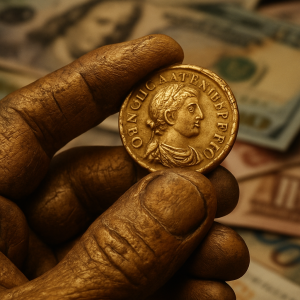
Paying for a coffee with a hundred-dollar bill is awkward today, just as spending an aureus at a local market was in ancient Rome. While the silver denarius was the commoner’s currency, the gold aureus was the heavy artillery of imperial economics. The practical separation between the Roman aureus and the silver denarius reveals a sharp social divide: gold was strictly reserved for massive land purchases and paying the vast legions securing the borders. This strategic division of wealth marked a major leap in the evolution of gold coinage systems.
Funding those massive armies eventually drained imperial vaults, leading emperors to a clever but dangerous trick: debasement. Think of a pure gold piece like a rich cake. When a baker runs out of expensive butter, they might sneak in cheap flour to keep the cake looking large. Desperate emperors did exactly this, secretly mixing base metals like copper into the gold to mint more coins. While it temporarily paid the soldiers, merchants quickly noticed the declining purity, causing prices to skyrocket in an early bout of inflation.
Despite these financial tricks, the aureus left a permanent mark on gold coin history. Even as the western Roman Empire finally crumbled, the concept of a universally trusted, high-value gold piece survived. The aureus proved that standardized currency could successfully connect entire continents. This enduring legacy laid the perfect foundation for the East, setting the stage for the Byzantine solidus to take the baton and confidently rule the global economy for the next 700 years.
The Byzantine Solidus: How a Single Gold Piece Ruled the Economy for 700 Years
While Roman emperors were busy watering down their wealth, their eastern successors in Constantinople decided to try something radical: honesty. Emperor Constantine introduced a high-purity coin called the solidus—also widely known across trade routes as the “bezant.” Instead of relying on the temporary tricks of debasement, the empire committed to a strict monetary standard, meaning the coin’s weight and gold content were fiercely protected by law.
For over 700 years, this unwavering consistency transformed the solidus into the “Dollar of the Middle Ages.” Whether you were buying silk in China or spices in India, the bezant was universally trusted. By refusing to cheat the system, the Byzantines ensured these historical gold coins acted as an anchor for global trade, achieving an unmatched stability in the history of precious metals.
That legendary reliability even left a permanent mark on our vocabulary. The Byzantine solidus’s economic impact was so profound that imperial troops demanded their wages exclusively in these reliable pieces; a man paid in a solidus literally became known as a “soldier.” Yet, as global markets expanded centuries later, carrying chests of heavy gold became increasingly cumbersome, establishing the necessity for the Medieval Florin and Venetian Ducat to become the credit cards of the Renaissance.

Why the Medieval Florin and Venetian Ducat Were the ‘Credit Cards’ of the Renaissance
Picture dragging a treasure chest across a bandit-filled continent just to buy silk. As the Renaissance sparked an economic boom, Italian merchants realized clunky money systems were stalling international commerce. To streamline trade, Florence minted the Florin in 1252, and Venice quickly answered with the Ducat. These weren’t just metal lumps; they were standardized units of wealth acting as the first international credit cards.
Their success stemmed from an absolute refusal to cheat the recipe. The Medieval Florin’s purchasing power was remarkably high—a handful could fund a Renaissance artist’s entire workshop. Venice took this dedication further. The Venetian Ducat’s trade history is defined by an astonishing 500-year streak where its gold purity never changed. Merchants finally had currency they could trust by sight, eliminating the tedious need to weigh every piece before a handshake.
Even with perfectly pure coins, transporting physical wealth remained dangerous. Consequently, ingenious Italians began locking their Ducats in secure vaults and trading paper receipts representing the coins instead. This brilliant leap birthed modern banking. However, as Europe’s appetite for wealth outgrew its local vaults, explorers looked across the ocean, setting the stage for the Spanish Doubloon: the most famous “piece of eight” and the gold that built the New World.
The Spanish Doubloon: The Most Famous ‘Piece of Eight’ and the Gold that Built the New World
Hollywood movies often blur the lines of pirate lore, mistakenly mixing up the silver “piece of eight” with the legendary gold Doubloon. In reality, the origin of the Spanish doubloon is rooted in a specific gold coin called an escudo (meaning “shield”). A true Doubloon was a two-escudo piece, a heavy chunk of wealth that funded global empires. Unlike perfectly round modern money, early versions of these historical gold coins were irregularly shaped “cobs” deeply stamped with a prominent cross. This design was an ingenious security feature; the intersecting lines made it instantly obvious if a thief had shaved precious gold off the edges, effectively stopping counterfeiters in their tracks.
Holding one of these rough-hewn coins meant wielding serious economic power. In a bustling 17th-century Caribbean port, a merchant dropping a single Doubloon on a tavern table wasn’t just buying a pint of ale. That lone coin possessed enough value to outright purchase:
- Several months of secure, comfortable lodging.
- A sturdy small boat for coastal trading or fishing.
- Several head of cattle to feed a ship’s crew.
Eventually, this massive influx of New World treasure triggered a painful economic lesson: monetary inflation. As galleons dumped literal tons of gold into Spain, the metal became less rare, meaning it suddenly took more coins to buy the exact same goods. Spain’s economy buckled under the weight of its own immense wealth, permanently altering global economics. Yet, humanity’s obsession with the yellow metal merely shifted geography, moving from the sinking galleons of the Spanish Main to the dusty riverbeds of California, initiating the era of the US $20 Gold Piece.
The History of the US $20 Gold Piece: From the Gold Rush to the Modern Collector
When fortune-seekers struck it rich in 1849, the sheer volume of California ore forced a massive upgrade in American money. This sudden explosion of raw wealth demanded a more efficient way to store funds, birthing the US $20 gold piece. Rather than hauling cumbersome bags of smaller coins or unrefined nuggets across the country, banks and businesses could now use a single heavy disk to represent a small fortune.
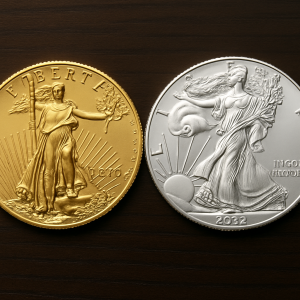
The 20 dollar gold piece’s famous nickname stems from a surprisingly simple system. The United States had already established the $10 coin as its standard gold unit, officially naming it the “Eagle” to honor the iconic American eagle. Because this massive new California-born coin was worth exactly twice that base amount, it naturally became known as the “Double Eagle.” This straightforward moniker stuck, creating a legendary denomination that perfectly matched the growing nation’s expanding economic muscle.
Despite their staggering purchasing power, everyday citizens rarely carried these heavy coins in their pockets to buy daily supplies. Instead, the Double Eagle functioned primarily as the muscle for massive government reserves and international bank transfers. Moving millions of dollars across the ocean to European banks was much easier when the wealth was condensed into these uniform, trusted units. While these early designs were strictly utilitarian, this massive canvas of gold eventually caught the eye of a visionary president, leading directly into the story of why the Saint-Gaudens $20 Piece is often called the most beautiful coin ever made.

Why the Saint-Gaudens $20 Piece is Often Called the Most Beautiful Coin Ever Made
President Theodore Roosevelt hated how ordinary American money looked compared to ancient Greek currency. Determined to elevate the US $20 gold piece, he hired renowned sculptor Augustus Saint-Gaudens. Together, they envisioned a miniature masterpiece. The resulting 1907 design broke traditional rules by introducing four striking elements:
- A triumphant Lady Liberty striding boldly toward the viewer.
- A brilliant sunburst illuminating the background.
- Unique edge lettering stamped directly on the rim.
- A dramatic “high relief” sculptural pop.
That final feature caused immediate chaos. High relief” means the artwork pops up significantly like a tiny 3D sculpture, requiring the mint to strike each gold blank multiple times with immense pressure. While breathtaking, bankers complained these thick pieces wouldn’t stack properly in their vaults. The government quickly flattened the molds to a standard “low relief” profile, keeping the majestic flying American eagle on the back but sacrificing the deep sculptural depth. These surviving early 1907 strikes are now primary rarity factors in numismatic gold markets.
Today, this artistic collaboration remains the undisputed champion of currency design. Yet, stamping a beautiful image is only half the battle; ensuring the raw metal survives decades of heavy commerce requires strict chemical control.
Understanding ‘The Recipe’: How Evolution of Purity Standards Protected Your Wealth
Imagine holding a coin made of pure, 24-karat gold. While stunningly radiant, this elemental perfection is incredibly soft—so pliable you could practically scratch it with a fingernail. If merchants constantly slid these pure pieces across rough wooden counters, the precious metal would simply scrape away over time. To solve this physical vulnerability, mints developed a strategic recipe, mixing pure gold with harder, cheaper metals like copper or silver.
This blending process drove the evolution of coin purity standards. By adding just enough copper, minters created “crown gold”—a robust 22-karat alloy capable of surviving decades of heavy commerce. This careful chemistry protected the underlying gold piece value, ensuring a coin’s physical durability didn’t compromise its wealth-storing power. Over centuries, this resilience helped establish the critical distinction between a coin’s raw bullion vs numismatic value, as well-preserved intricate designs became historically prized.
Trusting this invisible recipe required strict enforcement, leading to royal rituals like Britain’s famous “Trial of the Pyx.” During this centuries-old ceremony, independent juries meticulously weighed and tested random newly minted coins to guarantee the crown wasn’t secretly substituting expensive gold with cheap copper. While these rigorous standards allowed physical coins to anchor global commerce for generations, the sheer weight and logistical headache of moving tons of metal eventually forced a dramatic economic shift.
Why Nations Stopped Using Gold Currency: The Rise and Fall of the Gold Standard
Carrying heavy metal eventually exhausted a rapidly modernizing world. To adapt, governments introduced convenient paper “claim checks”—gold certificates representing actual coins sitting securely in a bank vault. This transition established the gold standard, a system tying every paper bill directly to physical reserves. The gold standard’s historical significance lies in its role as a strict economic anchor, providing remarkable price stability for over a century because nations couldn’t simply print more money than their physical vaults could actually support.
The Great Depression shattered this trusted system as panicked citizens hoarded their wealth. To regain economic control, President Franklin D. Roosevelt issued a pivotal 1933 executive order requiring Americans to exchange their private gold pieces for paper bills. This historic mandate abruptly paused the everyday history of gold as a circulating medium of exchange. Nations stopped using gold currency because governments desperately needed the flexibility to expand money supplies during catastrophic financial emergencies, a maneuver completely impossible when handcuffed to a limited supply of physical metal.
Once leaders severed this final metallic link, the global economy fully embraced fiat currency—paper money holding value simply by government decree rather than physical backing. Because gold pieces no longer circulated at the local grocer, surviving coins instantly transformed from basic spending cash into coveted artifacts. This dramatic shift created a modern financial paradox where one surviving gold piece might be valued at $2,000 as mere metal, while another auctions for $2 million.
Bullion vs. Numismatic Value: Why One Gold Piece is Worth $2,000 and Another $2 Million
Imagine holding two gold coins from the 1800s. Both weigh exactly the same, yet one sells for $2,000 and the other for $2 million. This massive gap illustrates bullion vs numismatic value. Bullion strictly refers to the melted-down metal weight, which is priced entirely by today’s global market. But the multimillion-dollar coin carries numismatic (collector) value. After all, just because a pocket-worn coin is incredibly old doesn’t automatically make it rare.
What actually elevates a coin from basic currency to a priceless artifact? Collectors evaluate four rarity factors in numismatic gold:
- Mintage: The original production total. Sometimes, a tiny stamped letter—a “mint mark” indicating the specific city of origin—identifies a drastically smaller, highly coveted batch.
- Survival Rate: Having millions originally minted means nothing if the government melted most of them down in 1933. This crucial rate measures how many actually exist today.
- Condition: Coins perfectly preserved from the daily wear and tear of commerce command massive premiums.
- Historical Significance: Pieces directly linked to famous shipwrecks or fallen empires constantly captivate eager buyers.
Breathtaking gold piece value is rarely about the raw metal itself; it is driven by the statistical miracles of what managed to survive. However, whenever prices soar based on microscopic details, counterfeiters emerge. Catching them requires knowing how to spot a fake using simple physical tests.
How to Spot a Fake: 3 Simple Tests to Identify Authentic Antique Gold Coins
- When fraudsters inevitably follow soaring market prices, the art of identifying authentic antique gold coins becomes an essential skill. Fortunately, catching a clumsy forgery rarely requires a chemistry lab; you often just need a strong refrigerator magnet. Gold is entirely non-magnetic. Because many counterfeiters mass-produce fakes using cheap, steel-based alloys hidden beneath a thin yellow plating, a simple magnetic swipe instantly exposes a massive percentage of fraudulent pieces in today’s market.
- Passing that initial hurdle brings us to the physics of density, traditionally called specific gravity. Gold packs immense mass into a remarkably tiny volume. If a scammer tries to replicate the exact weight of historical gold coins using a cheaper, lighter metal, the forged coin must be noticeably thicker or wider than the original. Conversely, if they match the precise dimensions, the fake will feel suspiciously light in your palm. Counterfeiters simply cannot fake this unique weight-to-size ratio without using actual gold.
- Finally, genuine precious metal possesses a unique voice known as acoustic resonance. Balancing a real coin on your fingertip and gently tapping it produces a distinct, long-lasting “ping” that rings like a tiny bell, whereas fake base metals produce a dull, abrupt clunk. Protecting your gold piece’s value relies on these enduring physical truths—magnetism, density, and sound. These tangible tests protected merchants for centuries and highlight why ancient history still matters in a digital world.
The Future of the Gold Piece: Why Ancient History Still Matters in a Digital World
You no longer have to view ancient coins as mere museum relics. You can now trace the evolution of gold coinage systems from ancient Lydian markets straight to the foundation of modern economics. The history of gold is not just a timeline of treasure; it is humanity’s original story of building financial trust.
This legacy reveals gold’s modern role as a critical store of value in our digital age. In an era of invisible digits and fleeting algorithms, a physical coin provides tangible financial insurance. It acts as humanity’s economic hard reset, remaining gracefully immune to collapse and easily outliving every paper currency ever invented.
Holding a historic gold piece at a local coin shop offers a tangible connection to this history. The heavy density that assured ancient merchants they weren’t being cheated still conveys an enduring worth today.
Whenever you encounter news about shifting banking systems, remember that solid disc. A gold coin isn’t just an obsolete currency; it is an indestructible anchor of wealth speaking a universal language across the centuries.
Q&A
Question: Why did civilizations converge on gold as money instead of iron, copper, or silver?
-
- Short answer: Gold has a “Goldilocks” mix of properties: it’s rare enough to be valuable but common enough to find; it doesn’t rust or tarnish; and it melts at temperatures ancient societies could manage. Those chemistry advantages made it a universal, easily recognized store of wealth that retained value even as empires rose and fell.
Question: How did minting solve early trade friction, and what’s the tension between face value and intrinsic value?
-
- Short answer: Stamping a fixed weight and purity with a ruler’s seal removed the need to weigh nuggets at every sale, creating instant, portable trust. The mint took a fee (seigniorage) for guaranteeing that standard, introducing a lasting tension between a coin’s declared “face value” and its intrinsic metal value.
Question: What caused Roman inflation, and how did the Byzantine solidus avoid that fate?
-
- Short answer: Rome stretched its treasury by debasing gold—mixing in cheaper metals—so more coins could be struck, which merchants noticed, triggering price spikes. Byzantium did the opposite: the solidus (bezant) kept rigorously consistent weight and purity for centuries, becoming the “Dollar of the Middle Ages” and even lending its name to the “soldier” paid in solidi.
Question: Why were the Florin and Venetian Ducat like “credit cards,” and how did they lead to banking?
-
- Short answer: Their unwavering purity and standardized weight made them trusted, portable units across borders—money merchants could accept by sight. To reduce the risk of moving physical gold, Italians stored coins in vaults and traded paper receipts instead, a practical leap that birthed modern banking.
Question: Why did nations abandon gold currency, and what changed about gold coins afterward?
-
- Short answer: The gold standard tethered paper money to finite metal reserves, delivering stability but limiting crisis response. During the Great Depression, governments (notably via the U.S. 1933 order) broke the link to expand money supplies, ushering in fiat currency; from then on, gold coins shifted from everyday cash to reserves and collectibles whose value now hinges on bullion content versus numismatic rarity.