Gold Eagles for Sale
Imagine holding a piece of history that won’t just sit in a digital bank account, but rests heavily in the palm of your hand. For decades, traditional investments have felt increasingly abstract, often leaving savers staring at glowing screens to verify their life’s work. Investing in physical gold coins changes that dynamic entirely by offering a tangible weight of security you can actually feel.
Financial professionals frequently point out that paper assets—like stocks or digital gold funds—represent a promise rather than a possession. According to historical market data, the anxiety tied to these intangible investments reliably spikes during periods of economic uncertainty. People naturally seek out real, physical bullion because it represents enduring wealth that isn’t dependent on a Wi-Fi connection or a brokerage firm’s survival.
This deep-rooted desire for reliable security is exactly why so many savers look for gold eagles for sale. Unlike unbranded gold bars, these specific coins carry an ironclad legal guarantee from the U.S. Mint regarding their exact weight, content, and purity. Tracing back to the Gold Bullion Act of 1985, this modern chapter of American bullion coin history established a safe, standardized way for the general public to own precious metals without worrying about counterfeits.
Knowing a sovereign government backs the physical asset inside your home safe provides a unique kind of peace of mind. By choosing recognized physical coins over paper contracts, you are acquiring a beautifully crafted financial foundation.

Summary
American Gold Eagles provide a tangible, government-backed way to own gold, born from the Gold Bullion Coin Act and guaranteed for weight, content, and purity. Minted in durable 22-karat alloy yet containing a full troy ounce of pure gold, their low face value is symbolic—the true price follows spot plus premiums and spreads. Buyers can choose fractional sizes, authenticate coins with simple at-home checks, purchase through vetted dealers, and even hold Eagles in Self-Directed IRAs. Blending iconic Saint-Gaudens artistry with strong liquidity and practical storage options, Eagles compare favorably to 24-karat Canadian Maple Leafs depending on priorities.
The 1986 Bullion Act: How the U.S. Mint Guaranteed Your Financial Security
Certainty is paramount when acquiring physical assets. In 1985, Congress passed the Gold Bullion Coin Act to give savers total confidence in their wealth. This legislation authorized United States Mint production of a standardized investment, creating a level of trust that simply doesn’t exist with privately made rounds. Unlike a private gold round, which relies solely on a private company’s word, a government-backed coin carries a strict federal guarantee.
To ensure American Gold Eagles became the safest physical investment available, the legislation established two powerful rules for the Mint:
- Domestic Sourcing: The gold must be newly mined from deposits located within the United States.
- Guaranteed Metrics: The federal government audits and guarantees the exact weight and purity of every single coin.
Beyond these strict production standards, the law granted these items official legal tender status. You might notice a symbolic face value—like $50—stamped directly on a one-ounce coin. While nobody would actually spend an asset worth thousands of dollars to buy groceries, this legal classification officially recognizes it as U.S. currency rather than just a regular piece of metal. However, to ensure this new currency could survive being held, traded, and passed down through generations without getting easily scratched or damaged, the Mint realized they couldn’t just use pure, soft gold.
Why 22-Karat Gold is the Professional Standard for Durability and Portability
Pure, 24-karat jewelry bends and dents easily under pressure. To solve this problem, the U.S. Mint revived a centuries-old standard known as “crown gold.” This creates an alloy—a mixture of metals designed to add strength. Instead of using pure gold, which is surprisingly soft, the Mint adds harder metals so the coin survives outside a museum case.
The exact recipe for American Gold Eagles consists of 91.67% gold, 3% silver, and 5.33% copper. This precise blend is what jewelers call 22-karat gold. By adding just a little silver and copper, the Mint dramatically increases the 22 karat gold durability, ensuring the coin won’t easily scuff when handled.
Naturally, hearing a coin is mixed with other metals might raise concerns about being shortchanged. Fortunately, the government anticipated this. Even though the piece is 22-karat, a one-ounce Eagle is minted slightly heavier to guarantee it contains exactly one troy ounce of pure gold inside. The silver and copper are simply bonus weight added for physical protection.
Holding one of these gold eagle coins in your palm, you immediately feel that protective strength. Yet, as you admire the durable surface, you will notice a surprisingly low dollar amount stamped on the back, prompting the question of why a heavy piece of precious metal declares itself to be worth only fifty dollars.
The $50 Paradox: Why the Stamped Value Doesn’t Reflect the True Market Price
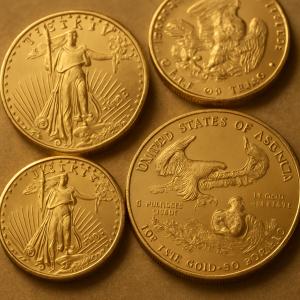
Looking at the reverse side of one-ounce gold eagles , you will see “50 Dollars” clearly stamped near the bottom. This small number often confuses buyers who just paid over $2,000 for the coin. The $50 is simply the coin’s face value, a symbolic figure required by law. In reality, the true worth comes from the spot price—the current global market value for the raw metal. Think of the $50 stamp like the original dealership sticker on a vintage car; the paper might say $3,000, but the modern market happily pays much more.
Having official legal tender status is exactly why the government includes this low dollar amount. This classification transforms a simple chunk of precious metal into recognized U.S. currency. That official status provides a massive layer of security for everyday buyers. Counterfeiting federal money is a severe crime, which gives you absolute peace of mind that the government guarantees the coin’s exact weight and purity.
Ultimately, the true gold eagle price is driven by the physical metal inside, not the symbolic number on the back. Yet, you are not just acquiring a guaranteed block of wealth. The breathtaking design turns this secure financial asset into a masterpiece of American art in your palm.
Saint-Gaudens’ Legacy: Owning a Masterpiece of American Art in Your Palm
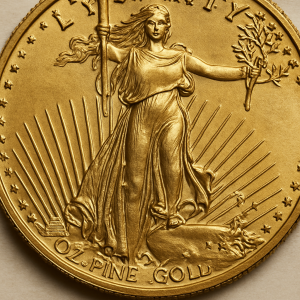
Flipping the coin to its front—known by collectors as the obverse —reveals Lady Liberty striding forward with a torch. This striking image traces its Saint-Gaudens design origins back to 1907, when President Theodore Roosevelt asked famed sculptor Augustus Saint-Gaudens to beautify the legendary $20 gold double eagles . This rich heritage adds numismatic value, meaning the piece is prized for its historical artistry, not just its raw metal weight.
The back of the coin, or the reverse , tells a different story depending on exactly when it was minted. From 1986 until mid-2021, all American Gold Eagles featured a classic “Family of Eagles” scene. This beloved image of a male eagle returning to a nest holding his female and hatchlings became a universally recognized symbol of family financial security.
Celebrating the coin’s 35th anniversary in 2021, the U.S. Mint introduced a sweeping design update. Buyers now distinguish between the original “Type 1” family design and the newer “Type 2” version. The Type 2 reverse highlights a beautifully detailed, close-up profile of a bald eagle’s gaze, which incorporates advanced security features to safely protect your physical investment.
Whether you prefer the classic nest or the modern eagle profile, this masterful artwork is stamped onto several coin sizes to comfortably fit your budget. Appreciating this historical beauty naturally leads to the next practical step: deciding how much metal to hold, and exploring everything from 1/10 oz to 1 oz to choose the right weight for your savings goal.
From 1/10 oz to 1 oz: Choosing the Right Weight for Your Savings Goal
Entering the gold market doesn’t require emptying your savings account all at once. The U.S. Mint deliberately designed these physical assets to be accessible to everyday Americans by offering fractional weight bullion coins. This simply means you can purchase a smaller fraction of a full ounce, allowing you to securely build your “rainy day” fund at a pace that matches your personal budget.
To accommodate different financial capabilities, the Mint produces the series in four specific weights. Each size carries a symbolic dollar amount stamped on the back to verify its status as official U.S. currency, even though the physical gold inside is worth much more on the open market:
- 1 oz ($50 face value)
- 1/2 oz ($25 face value)
- 1/4 oz Gold Eagles ($10 face value)
- 1/10 oz (often recognized as 5 Gold American Eagles due to their five-dollar face value)
Scale provides helpful context when deciding which size best fits your goals. The standard one-ounce coin is roughly the diameter of a half-dollar, carrying a satisfying, heavy presence in the palm of your hand. Conversely, the 1/10 ounce version is about the size of a common dime, making it a highly popular, affordable starting point for new buyers or a meaningful physical asset to pass down to grandchildren.
Be aware that this affordability comes with a minor financial trade-off. Because it takes more physical manufacturing effort to strike ten separate 1/10 ounce coins than one large coin, smaller pieces carry a slightly higher markup per ounce. Exploring exactly how this markup affects your checkout price leads directly into understanding premiums, spot prices, and dealer fees.

The ‘Bread Analogy’: Understanding Premiums, Spot Prices, and Dealer Fees
Figuring out the exact gold eagle price is remarkably similar to buying a loaf of fresh bread at the grocery store. Just as you pay for more than the raw wheat harvested by a farmer, you pay more than the baseline value of the gold inside the coin. That raw, daily-changing market value is known as the “spot price.” The additional amount you pay on top of it is called the premium, which simply covers the U.S. Mint’s manufacturing costs, secure transportation, and the dealer’s business expenses.
When you decide to buy gold eagles, you will encounter two specific numbers at the dealership: the “ask” and the “bid.” The “ask” is the total retail price you pay to purchase the coin, which equals the spot price plus the premium. Conversely, the “bid” is the slightly lower amount the dealer will pay you if you sell the coin back to them later. For example, if the daily gold spot price sits at $2,000, a dealer might “ask” $2,100, leaving a $100 gap that is commonly referred to as the spread.
Shoppers who understand these baseline mechanics rarely overpay when evaluating gold eagles for sale. A reputable shop typically charges a 5% to 8% premium over the spot price for a one-ounce coin. Grasping this simple math allows you to confidently shop around without fearing hidden fees. However, securing a fair price is only half the transaction; making sure that physical asset is completely genuine is the crucial next step.
Protecting Your Investment: How to Spot Fake American Gold Eagles at Home
Securing a fair price means little if you secretly worry your new asset isn’t genuine. While counterfeit gold eagles do exist in the wild, the U.S. Mint’s extreme manufacturing precision gives everyday buyers a massive advantage. Gold is incredibly dense, meaning its specific gravity—the unique ratio of its heavy weight compared to its relatively small physical size—is nearly impossible for scammers to duplicate using cheaper base metals.
You don’t need a professional science lab to protect your savings; simply run this 4-step checklist for home authentication:
- Weight check: Because of its durable 22-karat alloy, a genuine 1 oz coin will weigh exactly 33.93 grams on a digital scale.
- Diameter/Thickness check: It must measure exactly 32.7mm across and 2.87mm thick. If fakers use lighter metals, they are forced to make the coin noticeably thicker or wider to reach the correct weight.
- Magnet test: Real gold and its copper-silver alloys possess completely non-magnetic properties. If a strong refrigerator magnet sticks to the metal, it is undeniably a fake American Gold Eagle.
- The ‘Ping’ test: Gently tapping a balanced coin with another piece of metal produces a long, high-pitched ring, unlike the dull thud of lead.
Detecting counterfeit numismatic coins actually starts before the purchase is ever made. Always remain intensely skeptical of online listings offering coins significantly below the daily spot price, as well as sellers hiding behind blurry photos. Mastering these basic physical checks provides wonderful peace of mind, but your absolute best defense is buying from safe sources initially.

Where to Find Real Gold Eagles for Sale Without Getting Scammed
Testing coins at home provides great peace of mind, but the easiest way to avoid counterfeits is bypassing risky sellers entirely. When you decide to buy gold eagles, understand that the U.S. Mint does not sell bullion directly to the public. Instead, they use “Authorized Purchasers”—heavily vetted wholesale companies that distribute genuine coins to the retail dealers you ultimately shop with.
Finding a trustworthy retailer requires treating your gold purchase like a major household investment by checking the Better Business Bureau (BBB) and verifying independent customer reviews. Simply searching the web for “gold eagles for sale” can be surprisingly confusing, occasionally returning overpriced collector sites or completely unrelated items—like a Philadelphia Eagles gold pendant—instead of the actual physical bullion you need.
Once you identify properly vetted dealers, you must weigh your two primary shopping avenues to complete the purchase:
- Local Coin Shops: The main pro is immediate physical possession and the ability to build a personal relationship with the owner. The con is that local shops often charge slightly higher premiums to cover their physical storefront rent.
- Online National Dealers: The pro is highly competitive pricing and vast inventory. The con is waiting for fully insured shipping, meaning you won’t hold the gold the same day you buy it.
Whether shopping locally or online, these secure purchases can easily scale into long-term wealth.
Adding Physical Gold to Your Retirement: The Rules for Precious Metals IRAs
When diversifying retirement portfolios with gold, many savers use a special account called a Self-Directed IRA. The IRS maintains strict purity rules for these accounts, generally requiring physical metals to be 24-karat, or 99.9% pure. Fortunately, the government wrote a unique legal exception specifically for American Gold Eagles; even though they are blended with copper and silver into a more durable 22-karat alloy, their official U.S. Mint backing grants them full precious metals IRA eligibility.
Protecting this tax-advantaged wealth involves one critical rule: you cannot keep IRA gold in a personal home safe. Instead, the government requires you to use a custodian—an approved financial institution that acts like a highly secure vault manager for your retirement funds. You still own the physical coins outright, but the custodian handles the required IRS paperwork and stores your assets safely in an insured, specialized depository facility on your behalf.
This professional oversight provides tremendous peace of mind, ensuring your physical nest egg remains legally compliant and protected from theft. While the U.S. Mint’s flagship bullion dominates domestic retirement accounts, savers often weigh it against its completely unalloyed northern neighbor.
American Eagle vs. Canadian Maple Leaf: Which North American Coin Wins?
Stepping into the precious metals market often introduces a classic rivalry: the American Eagle vs. Canadian Maple Leaf. While both hold exactly one troy ounce of gold, their manufacturing recipes significantly differ. The U.S. Mint intentionally blends gold eagle coins with copper and silver, whereas the Royal Canadian Mint uses unalloyed, 99.99% pure gold.
This metallurgical difference forces a choice between extreme purity and practical resilience:
- American Eagle: 22-karat, highly durable against scratches, backed by the U.S. government.
- Canadian Maple Leaf: 24-karat, pure but soft enough to dent, backed by the Canadian government.
Because unalloyed gold is naturally soft like lead, the 22-karat gold durability of the Eagle lets you comfortably handle your investment without ruining its surface. Conversely, Canadian Maples typically stay sealed in rigid plastic cases to permanently preserve their delicate, flawless finish.
Beyond this “handleability,” your physical location dictates which coin offers better value. In the United States, Eagles are instantly recognized by virtually every neighborhood dealer, guaranteeing unmatched cash liquidity when you decide to sell. However, whether you choose the rugged American coin or the pristine Canadian alternative, bringing physical wealth into your home introduces entirely new storage concerns.
The ‘Shoebox Fear’: Safe Storage and How to Liquidate Your Gold Fast
Holding a small fortune in your hand naturally triggers “the shoebox fear”—the anxiety that hiding wealth in a bedroom closet is risky. If keeping your gold at home, a standard homeowner’s policy is rarely enough because most strictly cap coverage for precious metals. You must add a specific insurance rider to genuinely protect your investment against theft.
For those uncomfortable acting as their own bank, professional alternatives solve the problem of where to store physical bullion. You can use a depository, which is a high-security warehouse built exclusively for precious metals. This practice, called vaulting, secures your coins in a fully insured, heavily monitored environment. Unlike a standard bank safe deposit box, private depositories offer superior, dedicated insurance coverage.
When you eventually decide to sell, you need to understand liquidity—the speed at which you can convert an asset back into spendable cash. Liquidating precious metal assets is incredibly fast when you own universally recognized gold eagles. Because local coin shops and national dealers completely trust their government-backed purity, they will gladly purchase them on the spot, turning your physical gold into cash in under 24 hours.
Knowing your wealth is both completely secure and instantly accessible provides true financial peace of mind. Now that you understand the mechanics of safe storage and fast cash conversion, you are ready to confidently make your first purchase.
Starting Your Collection Today: A Simple Roadmap for the First-Time Buyer
Navigating the market for American Gold Eagles requires clarity on specific metrics. By evaluating 22-karat durability, retail premiums, and weight standards, buyers can confidently transition into informed participants.
To execute a secure first purchase, use this simple checklist:
- Budget: Determine your exact spending limit, factoring in the dealer premium above the daily spot price.
- Dealer Search: Identify U.S. Mint authorized purchasers or highly rated local shops before you buy gold eagles.
- Verification: Confirm the dealer explicitly guarantees the official U.S. government weight and purity standards.
When evaluating gold eagles for sale, remember that building tangible wealth is a steady process. Start small—perhaps with a one-tenth ounce coin—and always check the current spot price before committing to a purchase.
Acquiring these physical assets represents more than a simple transaction; it establishes a guaranteed, tangible foundation for your financial future right in the palm of your hand.
Frequently Asked Questions
Question: What makes American Gold Eagles different from private gold rounds or bars?
Short answer: The Gold Bullion Coin Act of 1985 created American Gold Eagles with strict federal guarantees that private products don’t have. By law, Eagles are made from newly mined U.S. gold, and the U.S. government audits and guarantees each coin’s exact weight, content, and purity. They’re also legal tender, which adds a powerful anti-counterfeiting layer because duplicating federal currency is a serious crime. In short, you’re buying a government-backed, standardized asset—not just a private company’s promise.
Question: Why are Gold Eagles 22-karat, and do they still contain a full troy ounce of gold?
Short answer: The U.S. Mint uses a durable 22-karat “crown gold” alloy—91.67% gold, 3% silver, and 5.33% copper—to resist scratches and dents. Even though it’s an alloy, a 1 oz American Gold Eagle is minted slightly heavier (33.93 grams) so it still contains exactly one troy ounce of pure gold. The added silver and copper are simply extra weight for strength and longevity.
Question: If a 1 oz Eagle says “$50,” why does it sell for much more—and how is the real price set?
Short answer: The $50 is a symbolic face value required for legal tender status. The market price is based on the spot price of gold plus a premium that covers minting, secure transport, and dealer costs. At a dealer, you’ll see an “ask” (what you pay) and a “bid” (what they pay to buy back). Example: with spot at $2,000, a dealer might ask $2,100; that $100 difference reflects premium and spread. Typical 1 oz Eagles carry about a 5%–8% premium, while smaller fractional sizes often have higher per-ounce premiums due to higher manufacturing costs.
Question: How can I buy American Gold Eagles safely and verify they’re real?
Short answer: The U.S. Mint sells bullion only to Authorized Purchasers, who supply vetted retailers. Choose reputable local coin shops or established online dealers, check BBB ratings and independent reviews, and beware of listings priced well below spot or with blurry photos. At home, use simple checks:
- Weight: 1 oz Eagle should be 33.93 grams.
- Size: 32.7 mm diameter, 2.87 mm thickness.
- Magnet: Non-magnetic; attraction indicates a fake.
- “Ping” test: A real coin rings clearly, not with a dull thud.
Question: Can I hold Gold Eagles in a Self-Directed IRA, and how should I store them?
Short answer: Yes. Although IRAs generally require 99.9% purity, American Gold Eagles have a specific legal exception and are fully IRA-eligible. For IRAs, you must use an approved custodian and a specialized, insured depository—you can’t store IRA coins at home. For personal (non-IRA) holdings, consider adding an insurance rider to your homeowner’s policy or use a private depository for maximum security. When it’s time to sell, Eagles are highly liquid; trusted dealers typically buy them back quickly, often converting them to cash in under 24 hours.