How Much Is a Gold Bar Worth? A Complete 2025 Guide
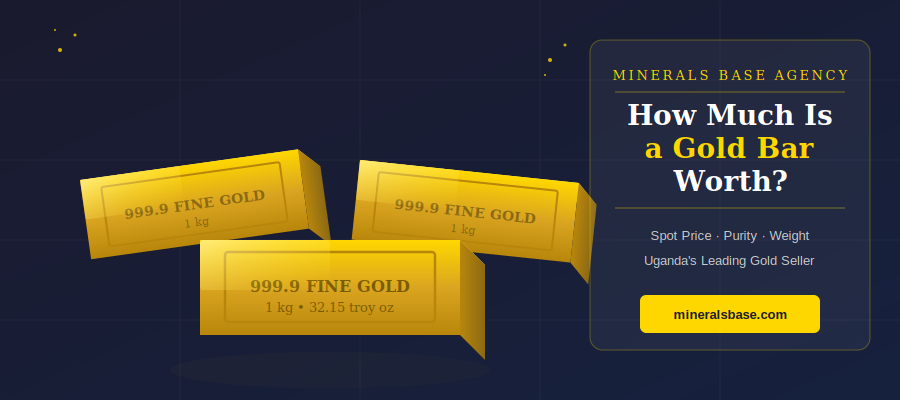
If you’ve ever Googled “how much is a gold bar worth,” you already know the answer isn’t a single number it shifts every day along with global markets, geopolitical news, and currency movements. The good news? Once you understand the factors that drive gold bar prices, reading the market becomes a lot easier.
At Minerals Base Agency Uganda’s leading gold seller and precious metals exporter we work with gold every day. In this guide, we break down everything: from purity and weight to live spot prices and the practical steps of buying or selling a gold bar safely. Whether you’re a first-time investor or a seasoned precious metals trader, this is the reference you’ll keep coming back to.
What Is a Gold Bar, Exactly?
A gold bar also called gold bullion or an ingot is a refined and stamped block of gold produced to meet strict weight and purity standards. Unlike gold jewellery, which is alloyed with silver or copper for durability, gold bars are manufactured specifically for investment and trade.
They range from a tiny 1-gram wafer that fits in your palm all the way up to the iconic 400-troy-ounce “Good Delivery” bar stored in central bank vaults. Each bar is stamped with its weight, fineness (purity), and the refinery’s hallmark details that directly determine its market value.
| Quick Fact
The world’s largest gold bar on record weighs 250 kg and was produced by Mitsubishi Materials Corporation in Japan. At current spot prices, it would be worth over $26 million USD. |
How Much Is a Gold Bar Worth? Key Factors Explained
The value of any gold bar comes down to three interlocking variables: the live spot price, the bar’s purity, and its weight. Understand those three, and you can calculate the worth of virtually any gold bar in seconds.
1. The Gold Spot Price
The gold spot price is the baseline price per troy ounce for immediate delivery of physical gold. It’s set continuously by the global OTC market and published by the LBMA (London Bullion Market Association). As of mid-2025, gold has been trading in the range of $3,200–$3,400 per troy ounce — a historic high driven by inflation concerns, central bank buying, and strong demand from emerging markets.
2. Gold Bar Purity (Fineness)
Purity is expressed as a fineness — a number that tells you how many parts per thousand are pure gold. A 24-karat bar has a fineness of 999.9, meaning it’s 99.99% gold. Lower-karat bars contain progressively more base metals:
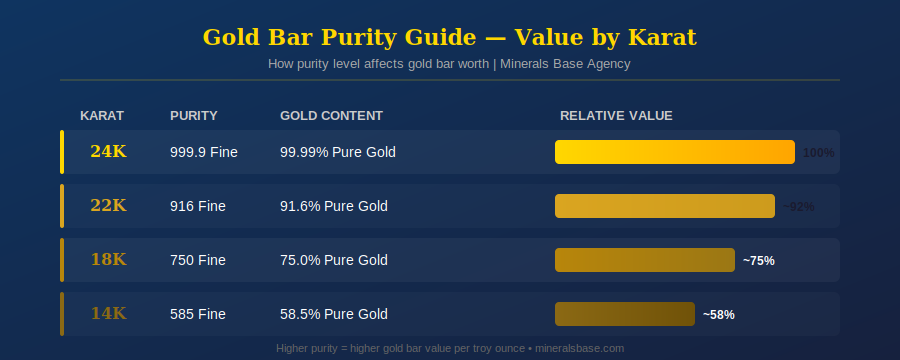
For investment purposes, 24K / 999.9 fine gold bars are the gold standard. They command a premium, but they’re the most liquid and universally accepted form of gold bullion in global markets.
3. Gold Bar Weight and Size
Gold is measured in troy ounces (ozt), where 1 troy ounce = 31.1035 grams. Here’s how standard gold bar sizes stack up:
| Bar Size | Weight (grams) | Weight (troy oz) | Approx. Value (24K) |
| 1 gram wafer | 1 g | 0.032 ozt | ~$103 |
| 5 gram bar | 5 g | 0.16 ozt | ~$515 |
| 10 gram bar | 10 g | 0.32 ozt | ~$1,030 |
| 1 troy oz bar | 31.1 g | 1 ozt | ~$3,230 |
| 10 troy oz bar | 311 g | 10 ozt | ~$32,300 |
| 1 kilogram bar | 1,000 g | 32.15 ozt | ~$103,900 |
| 400 oz (Good Delivery) | 12,441 g | 400 ozt | ~$1,292,000+ |
* Values are indicative based on ~$3,230/ozt spot price. Always verify with a live dealer quote.
What Else Affects Gold Bar Prices?
Beyond weight and purity, several market forces push gold prices up or down on any given day. Savvy investors track all of them.
Central Bank Demand
Central banks particularly in emerging markets like China, India, Russia, and across Africa — have been buying gold at record levels since 2022. When central banks add to their reserves, they reduce available supply and push spot prices higher. This structural demand has been one of the biggest drivers of gold’s 2024-2025 bull run.
Inflation and Real Interest Rates
Gold is widely regarded as an inflation hedge. When the purchasing power of paper currencies erodes, investors flock to gold to preserve wealth. More specifically, it’s real interest rates — nominal rates minus inflation — that matter most. When real rates are negative or near zero, gold becomes significantly more attractive.
Geopolitical Risk and Safe-Haven Demand
Wars, trade disputes, banking crises, and political instability tend to spike gold prices as investors seek safe-haven assets. Gold has no counterparty risk — unlike bonds or stocks, it doesn’t depend on a government or corporation to honour a promise. That makes it uniquely valuable in times of uncertainty.
Dealer Premiums and Fabrication Costs
When you buy a physical gold bar, you’ll pay a premium above the spot price. This covers the refinery’s minting and fabrication costs, the dealer’s margin, and sometimes storage or insurance. Premiums are typically lowest on larger bars — 1 kg and up — because the per-ounce cost of production is lower. Smaller 1-gram wafers carry proportionally higher premiums.
| Pro Tip from Minerals Base Agency
If you’re buying gold bars as a long-term investment, 1 oz and 1 kg bars offer the best balance of liquidity and cost efficiency. Smaller denominations are great for gifting or incremental saving but cost more per gram of actual gold. |
Minerals Base Agency Uganda’s Leading Gold Seller
Understanding gold prices is one thing — actually sourcing authentic, investment-grade gold is another. That’s where Minerals Base Agency comes in.
Based in Uganda, one of East Africa’s most gold-rich nations, Minerals Base Agency is the region’s premier supplier of certified gold bars, gold dust, and gold nuggets. We connect international buyers, institutional investors, and wholesale traders directly with responsibly sourced Ugandan gold — cutting out middlemen and delivering transparent, competitive pricing.
Why Source Gold from Uganda?
- Uganda holds significant alluvial and hard-rock gold deposits, particularly in the Karamoja and West Nile regions
- Ugandan gold averages 22K-24K natural purity, requiring minimal refining for investment-grade standards
- Direct sourcing means pricing closer to spot, without multiple trading layers inflating costs
- The Ugandan government has been strengthening mineral export frameworks, improving traceability and compliance
- Minerals Base Agency is fully licensed and operates within OECD due diligence frameworks for responsible mineral supply chains
What We Offer
| Product / Service | Details |
| Gold Bars (bullion) | 22K and 24K certified gold bars from 1 oz to 1 kg and above, with assay certificates |
| Gold Dust & Nuggets | Natural alluvial gold directly sourced from licensed Ugandan miners, available in bulk |
| Live Gold Market Rates | Transparent pricing tied to the daily LBMA spot fix — no hidden fees |
| Export Documentation | Full export permits, certificates of origin, and compliance documentation for international buyers |
| Procurement Services | End-to-end procurement support for institutions, refineries, and large-volume buyers |
| Our Reach
Minerals Base Agency has facilitated gold exports to buyers in Europe, the Middle East, Asia, and the Americas. Our track record of transparent transactions and on-time delivery has made us the trusted partner of choice for international precious metals buyers seeking African-sourced gold. |
How to Calculate the Value of a Gold Bar
Calculating what a specific gold bar is worth is straightforward once you have the spot price. Here’s the formula:
| Gold Bar Value = Spot Price (per troy oz) x Weight (troy oz) x Purity (%) |
Example: You have a 1 kg 24K gold bar (999.9 fine). Spot price is $3,230/ozt.
- Weight in troy oz: 1,000 g divided by 31.1035 = 32.15 ozt
- Purity: 99.99% = effectively 1.0
- Value: 32.15 x $3,230 x 1.0 = approximately $103,845
Add the dealer’s premium (typically 1-3% on kilo bars) and that’s your real-world cost or sale price.
Buying a Gold Bar: What You Need to Know
Buying a physical gold bar isn’t complicated, but there are a few things you genuinely don’t want to skip:
Buy from Accredited, Verifiable Sellers
Always purchase from dealers who provide an assay certificate or LBMA-approved hallmark. Counterfeit gold bars — often tungsten cores plated in gold — do exist in the market. A reputable seller like Minerals Base Agency will always provide documentation you can independently verify.
Understand What You’re Paying For
The all-in price of a gold bar includes the spot price, the fabrication/minting premium, the dealer’s markup, shipping and insurance (if applicable), and any storage fees. Ask for a full breakdown — any reputable dealer will provide it without hesitation.
Storage and Insurance
Storing gold at home is possible but carries risks. A home safe offers basic protection, but for significant holdings, a professional vault or allocated storage account at a bank or specialist custodian is the smarter option. Allocated storage means your specific bars are held separately and insured against theft and loss.
Selling a Gold Bar: Getting the Best Price
When it’s time to liquidate, where and how you sell your gold bar has a significant impact on how much you actually receive:
- Compare offers from at least three buyers — prices can vary by several percentage points
- Time your sale during periods of high gold prices or rising market momentum
- Keep your original assay certificate and purchase documentation — buyers pay more for authenticated bars
- Avoid pawn shops and high-street jewellers for bullion sales; they typically offer below-market rates
- Consider online bullion exchanges or specialist dealers who offer buy-back programmes at tighter spreads
| Minerals Base Agency Buy-Back Programme
Existing Minerals Base Agency clients benefit from our buy-back programme, where we repurchase gold bars at competitive rates tied to the daily LBMA fix. Contact us at mineralsbase.com to find out more about our buy-back terms. |
Gold Bar Investment: Is It Worth It in 2025?
Gold has returned an average of around 8-10% per year over the past two decades — competitive with many equity indices but with far lower correlation to stock market swings. In 2024 and into 2025, it has outperformed most major asset classes. Still, gold is a long-term store of value, not a short-term trading vehicle.
For investors in Uganda and across East Africa, gold offers an additional benefit: it’s priced in USD, providing a natural hedge against local currency depreciation. As the Ugandan shilling and other regional currencies have faced pressure in recent years, dollar-denominated gold holdings have outperformed significantly in local currency terms.
Whether you’re looking at a 1 oz gold bar as a starter investment, a kilogram bar as a serious portfolio anchor, or bulk gold dust procurement for commercial purposes, Minerals Base Agency is your trusted partner at every step.
Frequently Asked Questions
How much is a 1 oz gold bar worth right now?
A standard 1 troy oz (31.1 g) 24K gold bar is worth the current spot price — roughly $3,200-$3,400 in mid-2025 — plus a dealer premium of about 2-5%. Check mineralsbase.com or platforms like Kitco for live rates.
How much is a 1 kg gold bar worth?
A 1 kilogram 24K gold bar contains 32.15 troy ounces. At $3,230/ozt spot, that’s approximately $103,850 before dealer premium. Kilo bars typically carry premiums of 1-2% over spot due to their relatively low per-unit production cost.
What is a Good Delivery gold bar?
A Good Delivery bar is the standard used by central banks and LBMA-approved trading. It weighs between 350 and 430 troy ounces and must have a minimum purity of 99.5%. These bars are almost exclusively held in professional vaults and traded between institutions.
Is 24K gold the purest gold bar I can buy?
In practice, yes. The highest investment-grade standard is 999.9 fine (four-nines) — 24 karat gold that’s 99.99% pure. Theoretically perfect 100% purity is impossible to achieve in mass production, so 999.9 is the industry benchmark.
Can I buy gold bars from Uganda?
Absolutely. Minerals Base Agency facilitates legal, documented gold exports from Uganda to international buyers worldwide. Uganda produces high-purity alluvial gold, and our procurement services include full export compliance, assay certification, and logistics coordination. Reach out through mineralsbase.com to discuss your requirements.
What is the difference between gold bullion and gold coins?
Gold bullion bars are produced purely for their metal content value. Gold coins — like the South African Krugerrand, the American Gold Eagle, or the Canadian Maple Leaf — are minted by sovereign governments and carry a face value, though their market value is determined by their gold content. Coins often carry higher premiums than bars due to collectibility, but bars are more cost-efficient for larger investments.
Final Word: Know What You’re Buying — and Who You’re Buying From
The question “how much is a gold bar worth?” has a simple mathematical answer: spot price x weight x purity. But the more important question is whether the gold you’re buying is authentic, fairly priced, and sourced responsibly.
That’s what Minerals Base Agency delivers every day. With deep roots in Uganda’s gold sector, transparent pricing, full compliance documentation, and a growing network of satisfied international clients, we are East Africa’s trusted name in gold bullion trade.
Ready to get a live quote, explore bulk procurement, or simply learn more about investing in African gold? Visit us at mineralsbase.com or contact our team directly. We’re here to help you make every gold transaction count.
| MINERALS BASE AGENCY
Uganda’s Leading Gold Seller Certified Gold Bars · Gold Dust · Wholesale Gold Procurement www.mineralsbase.com |