Gold Coin Size Chart
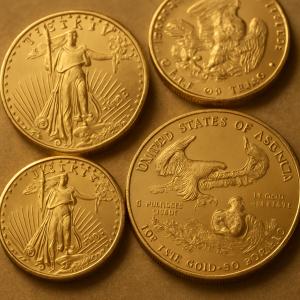
Holding a one-ounce Gold American Eagle often surprises new buyers, as it perfectly matches a U.S. Half Dollar’s diameter while feeling significantly heavier. Shopping online brings a different challenge because zoomed-in screens can make a tiny tenth-ounce piece look incredibly massive. According to standard mint specifications, two pieces holding the exact same amount of precious metal can feature vastly different physical profiles.
Much of this mystery comes down to the difference between a troy ounce—the traditional measurement for gold coin weights—and a piece’s actual physical footprint. Just like comparing a deep-dish pizza to a thin crust, mints alter the diameter-to-thickness ratio to suit their unique aesthetic designs. First-time buyers frequently expect uniform dimensions, only to find one brand surprisingly wide and another noticeably thicker.
To solve this deceptive scaling problem, a practical gold coin size chart serves as your perfect map. By evaluating the “Big Three” benchmarks—the American Eagle, Canadian Maple Leaf, and South African Krugerrand—we can build an intuitive coin size comparison. Anchoring these famous investments against everyday pocket change reveals exactly how they will feel in your palm.

The Standard Gold Coin Weight and Diameter Chart
Shopping for precious metals online often creates an optical illusion, as close-up website photos make every piece look exactly the same size. Standard gold coin weights and diameters help you accurately predict the physical feel of a coin before it ever arrives in the mail. Because major mints produce bullion in established fractional sizes, learning these basic millimetric standards takes the guesswork out of your purchase.
Mastering any world gold coin size chart requires looking at the width measured straight across the face. Mints globally use millimeters (mm) to define these dimensions, which can feel abstract if you are only accustomed to inches. However, comparing these precise numbers to everyday pocket change makes visualizing a fractional gold coin size comparison incredibly easy.
Here is a quick reference guide using the popular American Gold Eagle fractional sizing as our baseline:
- 1 oz (32.7 mm): Almost exactly the width of a standard U.S. Half Dollar.
- 1/2 oz (27 mm): Just slightly larger than a standard U.S. Quarter.
- 1/4 oz (22 mm): Very close in overall size to a U.S. Nickel.
- 1/10 oz (16.5 mm): Visibly smaller than a common U.S. Dime.
While this basic coin diameter chart gives you a clear picture of the surface footprint, width is only half the story. You might hold two different coins containing the exact same amount of gold and notice they feel entirely different in your palm. That surprising variation leads directly into the thickness factor.
The Thickness Factor: Why Some Gold Coins Look ‘Chunkier’
Holding a heavy coin with a surprisingly small diameter is a unique experience. Just like a deep-dish pizza contains the same amount of dough as a large thin crust, a mint must balance a coin’s width against its depth. Because gold is exceptionally dense, mints face a strict physical trade-off. If a design team wants a smaller overall footprint for a coin, they must increase the metal’s depth to ensure the final weight remains perfectly accurate.
This deliberate balancing act explains why gold coins feature different thicknesses even within the same weight class. When evaluating your physical collection, these subtle variations in gold coin measurements dictate how your pieces actually fit together. A compact coin feels noticeably chunky in your palm, but it will not stack evenly alongside wider, flatter pieces. Recognizing specific gold coin dimensions is crucial when buying standard plastic storage tubes or capsules, where a slightly deeper edge completely changes the fit.
While aesthetic design choices dictate much of this physical shape, another hidden factor actively alters a coin’s overall volume. It is not just about how the gold is pressed, but rather what else is mixed into it before minting begins.
22k vs. 24k Purity: How Alloys Change Gold Coin Dimensions
Placing a 22-karat piece on a scale often panics new buyers when it reads heavy. This happens because mints guarantee every coin holds exactly one ounce of pure gold, but 22-karat versions include extra metals for durability. Think of adding milk to coffee; your morning caffeine remains identical, but the total volume in your mug increases.
This simple alloy addition directly impacts the physical footprint of your collection. Reviewing the troy ounce to gram conversion for coins shows that one ounce equals exactly 31.1 grams, perfectly matching standard pure 24k buffalo gold coin physical specifications. However, when you check Krugerrand diameter specifications, you will find this famous 22-karat coin is physically wider and weighs nearly 34 grams total. To fit the protective copper without reducing the promised gold content, the mint must physically expand the coin.
Your choice between a durable, mixed-metal alloy and a softer, pure 24k version ultimately changes how much space your investment occupies. Because purity levels dictate these subtle shifts in gross weight and width, guessing which plastic storage capsules to buy often leads to frustrating mistakes. Since your eyes cannot easily detect a two-millimeter difference across various metals, precise tools become necessary.

How to Measure Your Coins Like a Pro
Counterfeiters often struggle to perfectly match both the exact weight and the physical dimensions of genuine gold. Because cheaper metals require more space to hit that one-ounce mark, identifying authentic gold coins by size remains your best defense against fakes. To verify your pieces accurately, a digital caliper is essential—a simple, affordable tool that measures down to a microscopic 0.01 millimeters and removes all the guesswork from authenticating your investment.
When measuring numismatic coins with digital calipers, your technique matters just as much as the tool. Follow this simple checklist to get professional results without damaging your collection:
- Set the caliper to zero before opening the jaws to ensure perfect calibration.
- Measure the diameter directly across the widest point of the coin.
- Measure thickness gently at the outer rim, carefully avoiding the raised artwork—or “relief height”—in the center.
Measuring coin thickness accurately in millimeters requires close attention to the outer boundaries. For instance, a coin featuring a grooved, reeded edge might grip the caliper jaws slightly differently than a perfectly smooth edge, so always apply light pressure to avoid scratching the soft gold. Documenting these millimeter-perfect dimensions provides the exact data needed for protective storage.
Selecting the Right Coin Capsule Size
Selecting the proper coin capsule size is the next step to keeping gold pristine. Dropping a small coin into a large case causes it to rattle, leading to damaging rim wear. To prevent this, you can choose between two protective styles: “Direct Fit” and “Gasket.” A Direct Fit holder acts like a custom phone case, molded perfectly to hug the metal. Alternatively, a Gasket style uses a soft foam ring to grip the coin, smoothly accommodating unusual dimensions.
Securing your investment means checking the capsule’s inner diameter (ID)—the actual empty space inside the plastic. Align your measurement to find the correct air-tite holders for various coin diameters:
- 32mm: Fits 1 oz American Eagles and Krugerrands.
- 30mm: Perfect for 1 oz Canadian Maple Leafs.
- 16mm: Sized for tiny 1/10 oz pieces.
Assuming all one-ounce gold fits into a standard 32mm case is a common beginner mistake. Recognizing these physical differences ensures your collection stays secure in storage.
From the 3 Yuan Panda to the Gold Buffalo: Unique Mint Specs
While securing gold in standard capsules is straightforward for one-ounce pieces, history doesn’t always play by modern rules. Many sought-after world coins rely on traditional weights established long before the current fractional system. For instance, reviewing sovereign and half sovereign measurements reveals a standard British Sovereign weighs exactly 0.2354 troy ounces, giving it a 22.05mm diameter—sizing it roughly between a U.S. nickel and a quarter.
Modern mints also produce fascinating fractional exceptions that require special attention. The Chinese Mint heavily utilizes grams instead of ounces, leading to incredibly tiny specialty issues. If you consult a 3 yuan gold coin size chart, you will notice this particular Panda weighs just one gram and measures a mere 10mm across, making it smaller than a standard dime.
Conversely, the American Gold Buffalo represents the pinnacle of pure 24-karat bulk. Because it contains no copper or silver alloys like the 22-karat Eagle, the buffalo gold coin physical specifications dictate a highly specific physical footprint. It matches the Eagle’s 32.7mm width but requires a slightly thicker profile, perfectly showcasing how unmixed gold handles in the palm of your hand.
Knowing these specific physical traits prevents purchasing the wrong protective display. Whether handling historic British gold or tiny modern grams, knowing their true size prevents mail-day surprises.

Your 3-Step Action Plan for Buying Gold Coins
Recognizing the physical differences between various coin weights and purities provides a strong first line of defense against counterfeits. Identifying authentic gold coins by size is as simple as comparing your piece to a trusted specification chart using a digital caliper.
Before finalizing a purchase, follow this routine:
- Check official mint specifications.
- Buy exact-matching capsules.
- Verify size upon delivery.
Equipped with accurate dimension data, you can properly plan your physical storage needs. Starting a collection with a familiar piece—like an accessible 1/10 oz coin—allows you to verify its precise physical footprint, confidently authenticate your precious metals, and securely protect your investment for the future.
Frequently Asked Questions
Question: Why can two one-ounce gold coins look different in size?
Short answer: A troy ounce measures weight, not dimensions, so mints trade diameter for thickness to hit the same mass. Design choices and purity also change the footprint. A coin can be made wider and flatter or smaller and thicker—both still containing one troy ounce of gold. Alloys matter too: 22k coins add metals like copper for durability while still guaranteeing one troy ounce of pure gold, which increases total volume and can make the coin physically wider or heavier overall. That’s why a 1 oz American Eagle, Canadian Maple Leaf, and South African Krugerrand can feel and stack differently even though they each contain the same amount of gold.
Question: What are the standard diameters for American Gold Eagle fractionals, and how do they compare to U.S. coins?
Short answer: Using the American Gold Eagle as the baseline: 1 oz is 32.7 mm (about the width of a U.S. Half Dollar), 1/2 oz is 27 mm (just larger than a Quarter), 1/4 oz is 22 mm (close to a Nickel), and 1/10 oz is 16.5 mm (smaller than a Dime). These everyday comparisons help you visualize true size when online photos make small coins look much larger than they are.
Question: How does 22k vs. 24k purity affect a coin’s weight and dimensions?
Short answer: Both 22k and 24k one-ounce coins contain exactly 31.1 grams of pure gold, but 22k coins include extra alloy for toughness. That added metal increases the coin’s overall weight and volume. For example, a 22k Krugerrand is physically wider and weighs nearly 34 grams in total, while a pure 24k coin matches the 31.1 g net gold content without extra mass. Design choices interact with purity too: the 24k American Gold Buffalo matches the Eagle’s 32.7 mm diameter but uses a slightly thicker profile, illustrating how purity and design together set the final “feel” in hand.
Question: How should I measure coins to verify authenticity and avoid damage?
Short answer: Use a digital caliper that reads to 0.01 mm and follow a careful technique: zero the tool first, measure diameter across the widest point, then measure thickness gently at the rim while avoiding the raised relief. Apply light pressure, especially on reeded edges, to prevent scratches. Counterfeiters struggle to match both weight and exact dimensions; cheaper metals need more volume to mimic a troy ounce, so matching your measurements to official mint specs is a strong first-line defense.
Question: What capsule sizes fit common coins, and what mistakes should I avoid?
Short answer: Match the capsule’s inner diameter (ID) to your coin’s measured diameter. As quick guides: 32 mm capsules fit 1 oz American Eagles and Krugerrands; 30 mm fits 1 oz Canadian Maple Leafs; 16 mm fits 1/10 oz pieces. Choose between Direct Fit (precision-molded) and Gasket (foam ring) styles—gaskets are forgiving for unusual dimensions. The most common mistake is assuming every one-ounce coin needs a 32 mm case; even a small 1–2 mm mismatch can cause rattling and rim wear or a too-tight fit.
Question: Are there notable size outliers I should know about?
Short answer: Yes. Historic and gram-based issues often fall outside standard ounce sizes. A British Sovereign weighs 0.2354 troy ounces with a 22.05 mm diameter—roughly between a U.S. nickel and quarter—so it needs different storage than quarter-ounce bullion. At the tiny end, a Chinese 3 Yuan Panda weighs just 1 gram and measures about 10 mm across, far smaller than a dime. On the pure-bullion side, the 24k American Gold Buffalo shares the Eagle’s 32.7 mm width but runs slightly thicker, underscoring how purity and design shape the in-hand profile.