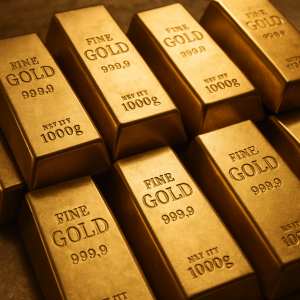
Gold Price Today
Have you ever seen the price of gold flashing in the news—say, $2,300 per ounce—and then wondered why a one-ounce gold coin costs even more at a shop? You’re not alone, and that difference isn’t a secret markup. The number you see on screen is the live spot price of gold, and it’s essentially the wholesale cost for financial markets, not the final retail price for you and me.
So, what is spot price exactly? Think of it like the bulk price a grocery store pays for an entire case of apples before they mark them up to sell individually. It’s the live market rate for a massive, 400-ounce bar of gold being traded between banks. To be precise, this price is always quoted per troy ounce, an industry standard for precious metals that is about 10% heavier than the regular ounce you might use for cooking.
This spot price acts as the fundamental building block for every gold item. From that baseline cost of the raw metal, factors like manufacturing, shipping, and the dealer’s own business costs are added to create the final price you pay. With this foundation, you can confidently navigate the value of any gold item you encounter.
Where Can You Check the Live Gold Price Right Now?
Tracking the live spot price of gold is easier than you might think, and you don’t need a special account to do it. The best way to check live gold rates is through reputable precious metal dealers or financial news sites that display this data for free. A few trusted sources include:
- Kitco.com
- APMEX.com
- The “Markets” section of Bloomberg.com
Once you’re on one of these sites, you’ll see the price changing in real-time. You will also notice two slightly different numbers labeled “bid” and “ask.” The concept is simple: the bid is the price dealers are currently offering to buy gold for, while the ask is the price they are asking you to pay for it. The small difference between them is called the spread.
Since the live price is quoted per troy ounce, these sites also make it easy to see the value in other units. Look for a chart or a dropdown menu that lets you view the current gold rate per gram or kilogram. This is especially helpful for quickly estimating the raw value of smaller items like jewelry before any manufacturing or retail costs are factored in. But why does this price change so much throughout the day?
The 3 Big Forces That Make the Gold Price Move
The constant flicker of the gold price isn’t random; it’s a direct response to major events unfolding across the global economy. While many factors influence gold prices, most can be boiled down to three powerful forces. These forces explain the story behind the numbers you see in the news.
First, consider the value of money itself. When inflation rises, each dollar buys fewer goods and services. As people see their cash savings losing purchasing power, many turn to gold as a tangible store of value that has historically weathered inflationary periods. This increased demand for a “real” asset can push the price of gold higher.
A second major factor is interest rates. Gold is an asset that doesn’t pay you anything for holding it—unlike a high-yield savings account or a government bond. When central banks raise interest rates, earning a safe return on your cash becomes more attractive, making gold less appealing in comparison. Conversely, when interest rates are low, holding gold becomes a more popular choice, often driving its price up.
Finally, there’s the ‘fear factor,’ often called safe-haven demand. During times of global uncertainty, like a major political crisis or a stock market downturn, investors get nervous. They often seek refuge in assets they perceive as stable and secure, and gold has served this role for centuries. This rush to safety can cause a rapid spike in its price. Of these forces, the one that most consistently affects your wallet is inflation, which can act as a powerful booster for gold’s value over time.
How Inflation Acts as a Rocket Booster for Gold Prices
Of all the forces that move the price of gold, inflation is the one you can feel most directly. You’ve noticed it at the grocery store or the gas pump: as prices for everyday items climb, each dollar you hold buys a little bit less than it did before. This erosion of your money’s ability to buy things is a loss of purchasing power. During these times, people naturally start looking for a safer place to park their wealth than a currency that is losing its value.
This is where gold’s most famous characteristic comes into play: its role as a store of value. Unlike cash, which can be printed in greater quantities and lose its worth, gold is a finite physical asset that has maintained its purchasing power for centuries. Think of it this way: decades ago, an ounce of gold could buy a fine men’s suit. Today, that same ounce of gold can still buy a very nice suit, while the original cash equivalent from that time might barely cover the cost of a new tie.
Because of this historical track record, many people turn to gold when they see high inflation on the horizon. This increased demand to shield their savings from losing value is what can send gold prices soaring, which is why you’ll often hear it called an “inflation hedge.” However, this isn’t a one-way street. Gold often finds itself in a tug-of-war with another powerful economic force that can pull its price in the opposite direction.
The Tug-of-War: Why Gold Prices Often Fall When Interest Rates Rise
While inflation can push gold’s value up, a force just as powerful can pull it back down: rising interest rates. Think about a bar of gold sitting in a vault. It’s valuable, but it doesn’t generate any income on its own—it won’t pay you interest like a savings account or a dividend like some stocks. This simple fact is at the heart of the relationship between the gold price and interest rates.
This creates a clear choice for savers and investors, one that highlights a concept called “opportunity cost.” Imagine you could put your money in a savings account that pays a guaranteed 5% interest per year. Alternatively, you could buy gold. By choosing gold, you’re giving up that guaranteed income in the hope that gold’s price will rise by more than 5%. The higher interest rates go, the more potential income you’re sacrificing. This makes holding zero-yield gold less attractive, often causing its price to dip as investors opt for the safer, interest-bearing alternative.
Because of this dynamic, paying attention to announcements from central banks, like the U.S. Federal Reserve, is key for anyone following the gold market. When they raise interest rates to fight inflation, it can put downward pressure on gold, highlighting how competing forces determine the price of gold. Conversely, when they cut rates, gold suddenly looks more appealing. But this isn’t the whole story. What happens when the economy itself feels shaky, regardless of interest rates?
Why Gold Is Called a “Safe Haven” in a Stormy Economy
Beyond the push and pull of interest rates, the price of gold is deeply tied to one simple emotion: fear. When the global economy feels stable and investors are confident, they often put their money into assets that can grow, like stocks. This is sometimes called a “risk-on” environment. But when uncertainty strikes—whether from a looming recession, a war, or a major bank failure—that confidence evaporates. Investors then scramble to protect their wealth in what’s known as a “flight to safety,” and for centuries, gold has been the ultimate destination.
This behavior directly impacts the gold price and stock market relationship. Often, when you see stock markets plummeting, you’ll see the price of gold climb. It’s not a coincidence. As investors sell off their stocks, they use that money to buy something tangible and historically reliable. Gold fits the bill perfectly because its value isn’t tied to a company’s profits or a government’s promises. This sudden spike in demand during a crisis is a key factor driving gold market volatility, as fear can drive prices up very quickly.
Think of it this way: for many large investors, holding gold as a safe-haven asset is like buying financial insurance. They don’t necessarily expect it to make them rich overnight. Instead, they hold it so that if their other investments lose value, their gold will likely hold steady or even increase, protecting their overall wealth. During the initial economic shock of the COVID-19 pandemic in 2020, for instance, gold prices surged as investors rushed for security. This demand for physical safety is a key reason gold holds its value, but it also leads to an important distinction in how it’s priced for everyday buyers.

The “Premium”: Why You Always Pay More Than the Spot Price
This desire for a tangible asset brings up a crucial question many first-time buyers have. You might check the live spot price online and see it’s $2,300 per ounce, but then find a one-ounce gold coin for sale at $2,450. Where does that extra $150 come from? Is it a hidden fee or a dealer markup?
That extra cost is known as the premium. In simple terms, the premium is the amount you pay over the spot price for a finished gold product. Think of the spot price as the wholesale cost a grocer pays for a big crate of apples. The price you pay for a single, polished apple at the store is always higher because it must cover shipping, store employees, and the grocer’s profit. The premium on gold works the exact same way.
When you buy a physical gold coin or bar, the final price tag is really a combination of a few distinct parts. The total cost is not just the gold itself, but also the process of getting that gold into your hands.
The final retail price includes:
- The Gold Itself: The raw value of the metal, based on the live spot price.
- Manufacturing and Minting: The cost to transform a large, raw bar of gold into a beautifully designed and precisely weighed coin.
- The Dealer’s Margin: This covers the seller’s business expenses—like secure storage, insurance, and staffing—and includes their profit.
This knowledge is the key to buying gold confidently. A premium isn’t a sign you’re being overcharged; it’s a normal and necessary cost for any physical gold investment. It’s the price of convenience, verification, and craftsmanship. Now that you know the theory, let’s see how these costs add up in the real world.
Let’s Price a Real Gold Coin: A Step-by-Step Walkthrough
Theory is useful, but let’s see how this works with a real-world example. Imagine you want to buy one of the world’s most popular coins: the one-ounce American Gold Eagle. The first thing you do is check the live spot price of gold. For our example, let’s say the current spot price is an even $2,300 per ounce. This means the actual gold contained within that one-ounce coin has a base value of $2,300. This number is your starting point, the foundation of the coin’s entire price.

Of course, when you find that coin for sale, you won’t see a $2,300 price tag. A reputable dealer might list it for around $2,420 . That extra $120 is the premium we just discussed. It covers the U.S. Mint’s intricate design and manufacturing costs, the dealer’s secure handling and overhead, and their profit. This premium is what turns a raw amount of metal into a trusted, easily traded physical gold investment. Tracking gold price fluctuations shows you how that base value changes day by day.
This same principle applies to smaller, more affordable coins, like the 1/10 ounce version shown above, though their premiums are often a bit higher as a percentage of the gold’s value. This is where knowing the current gold rate per gram can also be helpful for precise calculations. But this pricing is for investment-grade coins. What about the gold you might already own? Calculating the value of a gold ring or an old necklace uses a similar process, but with a few important extra steps.
What About My Jewelry? How to Estimate the Value of a Gold Ring
Unlike a pure gold coin, the jewelry you own is almost certainly a gold alloy—a mix of pure gold and other metals like copper or silver that add strength and durability. This is where the term “karat” comes in. A karat isn’t a measure of weight, but of purity. Pure gold is 24 karats (24k), so a ring stamped “14k” means that 14 parts out of 24 are pure gold.

This purity percentage is the key to finding what’s called the “melt value” of your item. For example, 14-karat gold is 58.3% pure (14 divided by 24), while 18-karat gold is 75% pure (18 divided by 24). To get a rough estimate, you would first weigh your jewelry, then multiply that weight by its purity percentage to find out how many grams of pure gold it contains.
Once you have the weight of the pure gold, you can multiply it by the current gold rate per gram to find its melt value. While the daily gold price news can cause this number to fluctuate, this simple calculation gives you a baseline value for the raw material in your hands. This is precisely the number a pawn shop or a “cash for gold” service would use as their starting point.
It’s crucial to remember, however, that the total value of gold jewelry is more than just its melt value. When you first bought that ring, you also paid for the artist’s labor, the brand’s design, and the retailer’s profit. While this craftsmanship adds significant sentimental and aesthetic value, the melt value represents the underlying commodity price of the gold itself. This distinction is important, as the world of gold ownership extends beyond just the physical items you can hold.
Physical vs. “Paper” Gold: What’s the Difference for a Beginner?
Moving beyond the gold you can wear, the world of gold investing is generally split into two camps. The first is owning “physical gold”—actual coins or bars that you can hold in your hand and store yourself. The alternative is often called “paper” or digital gold. The most common form is a Gold ETF (Exchange-Traded Fund), which functions much like a stock. When you buy shares in a Gold ETF, you own a piece of a massive trust that holds large gold bars in a secure vault on investors’ behalf.
The choice between them really comes down to a classic trade-off: tangible security versus digital convenience. For many, the appeal of physical gold is its independence from the financial system; you possess the asset directly. In contrast, digital gold offers unmatched ease, a key advantage for new investors. You can buy or sell your position with a few clicks from a standard brokerage account, sidestepping the challenges of storage and insurance that come with physical metal.
This fundamental difference also impacts the price you pay. Because digital products are traded in massive volumes on exchanges, their price tracks the live spot price—the number you see in the news—very closely. That number is largely determined by trading on major markets that use instruments like the COMEX gold price futures. However, any physical piece, from a small coin to a large bar, will always be sold for a “premium” above the spot price. This markup covers the costs of minting, shipping, and the dealer’s profit, making the physical gold vs digital gold investment decision one that directly affects your entry price.
Looking Back: What a Historical Gold Price Chart Really Tells Us
While daily price swings grab headlines, the real story of gold’s value appears when you zoom out. A quick look at a historical gold price chart reveals one undeniable fact: a powerful upward trend over the last 50 years. Since the early 1970s, when an ounce of gold cost around $40, its price has climbed into the thousands. This isn’t a random spike but a decades-long pattern that tells a story about money itself.
This dramatic climb isn’t just about gold becoming more popular. Crucially, it reflects money losing its purchasing power over time. The impact of inflation on gold value is profound; as the value of a dollar erodes, it simply takes more dollars to buy the same ounce of gold. For this reason, many view gold as a safe-haven asset not for quick profits, but as a way to preserve wealth across generations, holding its value against the slow melt of inflation.
However, that long-term chart is anything but a smooth, straight line. It’s a landscape of dramatic peaks and long valleys, with periods lasting years where prices fell or simply moved sideways. Gold’s value is tested by economic cycles, interest rate changes, and global stability. This history of volatility makes many people wonder if the timing is ever right. Deciding what today’s price really means begins with understanding this rhythm of long-term growth and short-term turbulence.
Is Now a Good Time to Buy Gold? How to Think for Yourself
This brings us to the most common question of all: is now a good time to buy gold? While many experts offer their opinions, the most helpful answer doesn’t come from them—it comes from you. Since you now understand the key forces that move the price, you can assess the economic weather for yourself. Instead of looking for a simple “yes” or “no,” the goal is to decide if current conditions align with your own expectations for the future.
A sound approach to gold investing begins with asking the right questions. Before making any decision, an informed person considers their own perspective on these points:
- Inflation: Do I expect the cost of living to keep rising, making my cash worth less?
- Interest Rates: Do I think rates are likely to fall, making gold more attractive than a savings account?
- Uncertainty: How stable does the stock market or global economy feel to me right now?
- My Timeline: Am I looking to hold this for many years, or am I hoping for a short-term gain?
There is no “perfect” moment to buy, and accepting that prices will always fluctuate is part of navigating gold market volatility. By answering these questions for yourself, however, you shift from being a passive spectator to an active, informed observer. You are no longer just watching the price; you are understanding the story it tells and deciding how it fits into your own financial life.
Your New Toolkit for Understanding the Gold Price
The “gold price today” is more than just a number on a news ticker—it is a powerful economic story. The mystery behind that number dissolves when you can separate the wholesale spot price from the retail premium on a finished coin or bar.
The value of gold is constantly shaped by a tug-of-war between inflation, which erodes the value of cash, and rising interest rates, which offer an alternative return. Layered on top is the element of human emotion—global uncertainty and fear often drive a “flight to safety,” pushing investors toward tangible assets.
With these core concepts, the daily headlines about gold are no longer abstract data. They become a readable narrative about our economy, about global confidence, and about the enduring value of a metal that has captivated humanity for centuries.
Frequently Asked Questions
Question: Why is the price of a gold coin higher than the live “spot price” I see on the news?
Short answer: The spot price is the wholesale, real-time market rate for raw gold—quoted per troy ounce and largely based on trading of big 400-ounce bars between financial institutions. A finished coin or bar you buy at retail includes a premium above spot to cover minting/manufacturing, shipping, secure handling, insurance, the dealer’s operating costs, and profit. That premium is normal—much like a grocery store charging more per apple than the bulk price of a crate.
Question: Where can I check the live gold price, and what do “bid” and “ask” mean?
Short answer: Reputable, free sources include Kitco.com, APMEX.com, and the Markets section of Bloomberg.com. You’ll see two prices: the bid (what dealers are currently paying to buy) and the ask (what they’re charging to sell). The small gap is the spread. Prices are quoted per troy ounce (about 10% heavier than a regular ounce), and most sites let you switch to grams or kilograms—useful for estimating the raw metal value of smaller items.
Question: What are the main forces that make gold prices move during the day? Short answer: Three big drivers dominate:
- Inflation: As purchasing power erodes, investors often buy gold as a store of value, pushing prices up.
- Interest rates: Gold doesn’t pay interest, so when rates rise, the opportunity cost of holding gold increases and prices often face pressure; when rates fall, gold can look more attractive.
- Safe-haven demand: During uncertainty (market stress, geopolitical shocks), fear prompts a “flight to safety,” boosting gold as investors seek stability. Day-to-day moves reflect this tug-of-war.
Question: How can I estimate what my gold jewelry is worth?
Short answer: Find the karat stamp to determine purity (24k is pure; 14k is 14/24 = 58.3% pure; 18k is 18/24 = 75% pure). Weigh the item, multiply by its purity to get grams of pure gold, then multiply by the current gold rate per gram to get its melt value. Remember, melt value reflects the raw commodity only; the retail price you originally paid also covered design, craftsmanship, and the seller’s margin. Buyers like pawn shops typically start from melt value.
Question: What’s the difference between owning physical gold and “paper” gold like a Gold ETF?
Short answer: Physical gold (coins/bars) is tangible and held directly, appealing to those who value independence from the financial system, but it comes with storage, insurance, and a premium over spot. “Paper” or digital gold (e.g., Gold ETFs) trades like a stock and closely tracks the live spot price because it’s backed by large vaulted bars and traded in high volumes (with prices influenced by markets that use instruments like COMEX futures). The trade-off is tangible security versus digital convenience and tighter pricing.