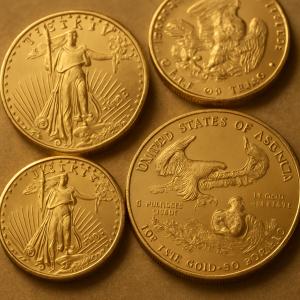
American Eagle Gold Proof Coins Value
Think of your favorite movie’s standard release compared to its spectacular “Director’s Cut.” While standard American Eagle coins are certainly impressive, the premium version is entirely different. It looks less like everyday currency and more like a carefully polished piece of fine jewelry.
This distinction sits at the heart of the American Eagle gold proof coins value. Most people buy standard “bullion”—regular investment gold—for basic financial security. Conversely, collectors seek out the proof versions for their breathtaking artistry, treating them as historical heirlooms rather than simple physical assets.
Summary
American Eagle Gold Proof coins are premium collector pieces distinguished by mirror-like fields, frosted details, multiple high-pressure strikes, and the West Point “W” mint mark. Their value exceeds melt due to exceptional craftsmanship, limited mintages (key dates), design shifts like the 2021 Type 1 vs. Type 2, and top third-party grades such as PF70 Ultra Cameo. Specs include 22-karat alloy with full troy-ounce gold content across fractional denominations, with authenticity signaled by official packaging and verifiable through basic tests. Buy from the U.S. Mint or authorized dealers and preserve coins in sealed capsules in climate-controlled storage to protect condition and value.
You can instantly recognize the premium upgrade by looking closely at the coin’s surface. Standard bullion gold usually has a consistent, shiny finish across the whole piece. A proof version features a highly reflective, mirror-like background combined with delicate, frosted imagery that makes the design seemingly pop off the metal.
Behind this stunning visual contrast lies incredible dedication to craftsmanship. According to the U.S. Mint, creating gold proof coins involves feeding specially polished blanks into manual presses. Workers strike each piece multiple times with extra pressure, ensuring every tiny feather on the eagle is captured in absolute perfection.
Because of this rigorous manufacturing process, these masterpieces carry a unique prestige factor. Buyers are not just paying for a heavy circle of precious metal when acquiring American gold coins in proof condition. Instead, they secure a limited-edition work of art, much like purchasing a rare painting.
The meticulous minting steps and strict production limits explain exactly how these brilliant treasures hold their long-term prestige, and why a coin with a mere $50 face value commands thousands of dollars.

Why the Mirror Finish Matters: Spotting the Visual Difference Between Bullion and Proof
If you have ever seen standard gold bullion coins, you likely noticed their even, bright shine. The U.S. Mint takes a completely different approach for proof gold coins. Before the pressing process even begins, workers take the blank metal disks—known as planchets—and carefully polish them until they reflect light like a piece of wet glass.
Think of the actual stamping process like a high-end printing press. Instead of hitting the metal just once, a specialized machine strikes the polished blank multiple times with immense pressure. These repeated die strikes force the gold into every microscopic groove of the mold, creating details far sharper than you would ever find on standard currency.
This intense manufacturing method produces a stunning visual contrast known as the “cameo” effect. Identifying authentic gold proof eagles requires spotting this unique contrast using a simple visual checklist:
- Mirrored field: The flat background of the coin should reflect like a flawless mirror.
- Frosted devices: The raised artwork will have a beautiful, matte finish that visually pops against the shiny background.
- Sharp edges: The borders and fine details will look perfectly crisp, never soft or rounded.
Anyone can take a cloth and rub a piece of metal until it shines, but a true Mint-struck Proof relies on extreme pressure and precise frosting to create this masterpiece finish. This brilliant contrast elevates the artwork itself and the legendary story behind the artist who created it.
The Legend of Saint-Gaudens: Why This Design Defines American Gold
When you look closely at that beautifully frosted artwork, you are actually looking at a resurrected piece of American history. In 1905, President Theodore Roosevelt decided that the nation’s currency was visually uninspiring. He wanted the country’s money to rival the high-relief beauty of ancient Greek art, so he hired a legendary sculptor to completely reimagine it.
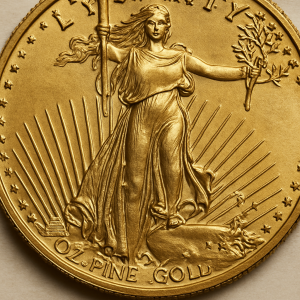
The artist’s resulting masterpiece, known as the Augustus Saint-Gaudens double eagle design, is still widely considered the most beautiful currency ever produced by the United States. He created a stunning vision for the coin’s obverse—the traditional term for the front or “heads” side of a piece of currency—featuring Lady Liberty striding confidently forward, bathed in the rays of the sun.
This iconic image was simply too spectacular to leave in the past. When the U.S. Mint began producing modern American gold coins in 1986, they chose this exact historic artwork for the front. Today, whether you are buying standard bullion or highly polished eagle gold coins, that same torch-bearing Lady Liberty connects your modern purchase directly to Roosevelt’s century-old vision.
Preserving such a legendary sculptural legacy requires incredible manufacturing precision, especially when creating the flawless mirror finishes that collectors demand. To ensure this exacting quality, the government entrusts the production of these brilliant proofs to a highly secure facility. The location of this facility is stamped right onto the metal, providing a crucial clue to the coin’s ultimate value.
The Significance of the ‘W’ Mark: Why West Point Minting Increases Value
Every time you examine one of these flawless pieces, a tiny detail tells the story of its elite origin. While standard pocket change is produced by the millions, premium pieces boast a much more exclusive birthplace. This heritage is indicated by a “mint mark,” a small letter permanently stamped into the design to prove exactly where the item was made.
Finding this crucial detail requires just a quick glance at the front of the coin. Look right below the year, near the tiny Capitol building beside Lady Liberty’s feet; there, you will see a distinct “W” etched into the metal.
That single letter represents the United States Mint West Point facility, a highly secure location that handles the nation’s precious metals. Because of this specialized security role, it never manufactures everyday currency like pennies or dimes. Instead, this elite branch is trusted exclusively to craft high-quality, limited-edition masterpieces.
The W mint mark instantly separates basic investment pieces from true collector treasures. Regular bullion eagles, meant strictly for raw gold investors, generally do not feature this mark. However, brilliant gold proof coins proudly wear the “W” as a guarantee that they received the mint’s painstaking, multiple-strike polishing process.

Decoding the 22-Karat Standard: Why Purity and Weight Matter for Your Investment
Pure gold is stunning, but notoriously soft—so fragile that a pure coin could easily scratch with standard handling. To solve this, the U.S. Mint utilizes 22-karat gold purity specifications, blending the precious metal with small amounts of silver and copper. This recipe hardens the metal, ensuring your collector piece remains flawless for generations.
You might wonder if this blending process means you are getting shortchanged on the gold itself. Thankfully, no. A one-ounce American Eagle actually weighs slightly more than an ounce overall. The Mint adds the protective alloy alongside a full “Troy Ounce”—the traditional precious metal measurement, which is slightly heavier than everyday grocery ounces.
Collectors often acquire these masterpieces individually or within a complete American Eagle gold bullion coins proof set. When purchasing the full collection, you receive the four-coin gold proof set weights, each stamped with an official face value:
- 1-ounce coin ($50 face value)
- 1/2-ounce coin ($25 face value)
- 1/4-ounce coin ($10 face value)
- 1/10-ounce coin ($5 face value)
Seeing “$50” stamped on a coin worth thousands of dollars can be confusing. That number is simply a symbolic guarantee making the coin official U.S. legal tender, rather than representing its true market value based on current gold prices. Beyond size and purity, a coin’s specific era heavily influences its worth, especially considering recent design changes.
Type 1 vs. Type 2: Navigating the 2021 Design Revolution
For over three decades, the back—or “reverse”—of the American Eagle remained entirely unchanged, serving as a comforting anchor for buyers. That long-standing tradition shifted dramatically in mid-2021 when the U.S. Mint unveiled the first major aesthetic overhaul in the coin’s history.
The original artwork, now affectionately classified by collectors as “Type 1,” features a traditional scene sculpted by Miley Busiek. This classic image depicts a male eagle flying above a nest carrying an olive branch to a waiting female and hatchlings, symbolizing national family values and protection.
To modernize the visual appeal, the Mint introduced a highly detailed close-up of a bald eagle’s head, bringing intense focus to the bird’s piercing gaze and beautifully textured feathers. These Type 2 gold eagle design changes breathe fresh life into the coin, offering a bold, contemporary look that contrasts sharply with the broader original scene.
Beyond pure artistry, this 2021 redesign incorporated advanced anti-counterfeiting technology directly into the physical metal. If you carefully inspect the grooved outside edge of a newer coin, you will notice a small, smooth interruption known as a “reeded gap”—an intentional missing notch that instantly verifies authenticity.
Owning both versions from the 2021 “transition year” has become incredibly popular for anyone looking to acquire historically significant eagle gold coins. These mid-year changes create a unique time capsule of American minting, elevating standard precious metals into highly collectible pieces that cost significantly more than their raw metal weight.

The Price of Perfection: Why Proof Coins Cost More Than Their Weight in Gold
Checking the daily financial news will give you the “Spot Price,” which is the current global market rate for raw, unmelted gold. While this number acts as the baseline for all precious metal transactions, buying an American Eagle Gold Proof involves a different financial equation. You will quickly notice these gleaming pieces cost significantly more than the daily news suggests.
Think of the spot price as the engine and frame of a standard car, while the extra cost covers a limited-edition luxury interior and custom paint. This additional cost is called the numismatic premium for collectible gold, representing the value of the minting craftsmanship, the coin’s historical significance, and its overall rarity.
A smart gold coin investment involves acquiring much more than a simple block of metal. Because the U.S. Mint produces these specific Proof versions in strictly limited quantities each year, their worth relies heavily on collector demand rather than just global mining outputs.
Once the Mint sells out of a particular year’s run, buyers and sellers trade them on the “secondary market,” much like a specialized auction house for previous releases. Several factors influencing secondary market pricing include how many coins were originally made, their current availability, and the intensity of collector desire for specific transition years.
To capture the highest premiums in this aftermarket, a coin must remain absolutely flawless. Because buyers will pay dramatically more for a piece that looks untouched by human hands, experts rely on rigorous grading scales to officially judge that physical condition.
Grading Scales Decoded: What PF70 Ultra Cameo Means for Your Value
Protecting that flawless condition requires more than just careful handling; it requires independent verification. When shopping for premium pieces, you will frequently see them sealed in tamper-proof plastic cases called “slabs.” These protective holders house certified gold coins that have been rigorously examined by independent third-party experts to guarantee their authenticity and exact physical state.
Two primary organizations set the industry benchmark for this evaluation. Using PCGS and NGC grading standards, evaluators inspect the metal under magnification to assign a number on a strict quality scale:
- 70 (Perfect): A flawless coin with zero visible marks under 5x magnification.
- 69 (Near Perfect): A stunning coin with an almost invisible microscopic imperfection.
- 60 (Average): An uncirculated piece with noticeable surface marks.
Seeing the letters “PF70 Ultra Cameo” on a label represents the ultimate achievement for a gold coin investment. “PF” simply stands for Proof, while “Ultra Cameo” means the frosted artwork intensely pops against the highly polished background. Although a grade of 69 looks virtually identical to the naked eye, collectors pay massive premiums for a perfect 70—just as buyers pay exponentially more for a flawless diamond over one with a microscopic speck.
Holding a certified flawless piece guarantees you own the best possible physical version of that specific release. Yet, perfection alone is only one half of the collector’s equation. The total number made is what dictates whether flawless eagles fetch astonishing prices or remain highly accessible.
The Power of Rarity: How Historical Mintage Figures Drive Value
Owning a flawless piece is thrilling, but its ultimate worth depends heavily on basic supply and demand. Think of a limited-edition car; a perfect paint job matters, but the vehicle becomes infinitely more valuable if the factory only built fifty. In coin collecting, this scarcity is driven by “mintage”—the official term for the total number of coins produced by the U.S. Mint in a given year.
Production numbers are never perfectly consistent. By researching historical mintage figures for gold eagles, you will see the Mint adjusts its annual output based on public interest and material availability. Years with the lowest production are known as “key dates.” These become fiercely pursued by enthusiasts because there simply are not enough pieces in existence to satisfy every buyer.
The price gap between common and uncommon releases illustrates how scarcity directly impacts the market for collectible gold coins:
- High-Mintage (2006): Over 45,000 one-ounce Proofs were manufactured. Being relatively accessible, they carry a smaller premium above the raw gold price.
- Low-Mintage (2012): Production dropped below 24,000. These instantly became rare gold coins, often demanding massive premiums simply due to their short supply.
Physical condition and rarity work together to determine value. Identifying which specific years hold the greatest potential is crucial before safely sourcing authentic pieces.
Buying with Confidence: How to Source Authentic Gold Proofs
Shopping online is second nature, but purchasing precious metals requires careful scrutiny. The absolute safest route is buying directly through the U.S. Mint upon release. For past years, you must navigate the secondary market by buying gold coins from authorized purchasers. These vetted retail dealers guarantee authenticity, offering far more security and peace of mind than anonymous sellers on auction websites.
Identifying authentic gold proof eagles starts with the packaging. An official American Eagle gold bullion coins proof set includes a velvet-lined presentation case and a Certificate of Authenticity. Beyond paperwork, physical checks are vital. Real gold is incredibly dense and completely non-magnetic. A simple “magnet test” is highly effective; if the coin sticks to a strong magnet, it is unequivocally fake. Likewise, a basic “weight test” on a digital scale must match official U.S. Mint specifications perfectly.
Protect yourself further by actively looking for these three critical red flags before completing any transaction:
- Too-good-to-be-true prices: If a premium proof coin is priced below the current market value of raw gold, it is a scam.
- Incorrect weight: Counterfeiters use cheaper, lighter metals to match the coin’s physical size, causing it to fail a basic weight test.
- Poorly defined details: Genuine proofs feature sharp, frosted artwork striking against mirror-like backgrounds, whereas fakes often appear muddy or uniformly shiny.
A successfully verified coin represents a thrilling milestone in your collection. Once that beautiful piece arrives, ensuring its flawless finish survives for generations requires proper storage and preservation.
Protecting Your Legacy: Proper Storage and Preservation of Gold Proofs
Holding your new treasure is thrilling, but that beautiful mirror finish requires immediate protection. While pure gold never rusts, the highly polished backgrounds of American gold coins are deeply sensitive to environmental damage. Airborne dust particles, excess humidity, and sudden temperature shifts can easily dull their brilliant shine if left exposed on a desk or open shelf.
The most common threat to these masterpieces actually comes directly from human hands. Our skin naturally produces mild acids and oils that are devastating to delicate metal surfaces. Pressing your thumb against the frosted artwork leaves a permanent fingerprint that can physically etch into the finish over time. If handling is absolutely necessary, always grip the coin strictly by its ridged outer edge.
To defend against both nature and accidental drops, experts rely on encapsulation. Implementing proper storage for certified gold coins involves sealing them inside hard, air-tight acrylic capsules. Think of this protective enclosure as a personal museum display case that completely locks out moisture while still letting you safely admire the intricate artwork.
Securing these magnificent collectible gold coins ultimately means keeping those sealed capsules in a dark, climate-controlled environment like a home safe or bank deposit box. By treating your purchase like a precious artifact, you guarantee its flawless survival for future generations.
Your Action Plan for Starting an American Eagle Gold Proof Collection
These beautiful pieces are far more than just shiny currency. The meticulous striking process and limited total mintage dictate the American Eagle gold proof coins’ value well beyond their raw metal content. Balancing the stunning artistry of these strikes with their potential for reliable wealth preservation requires a personalized collecting strategy.
Follow this simple framework to secure your own collectible gold coins with confidence:
- Set a budget: Decide if you are starting with a smaller, fractional size or a full one-ounce piece.
- Pick a year: Look for a special anniversary date, a birth year, or a specific design iteration that catches your eye.
- Choose a grade: Determine if you want a certified flawless coin or a beautiful, standard Proof direct from the mint.
- Select a dealer: Only purchase directly through the U.S. Mint or their vetted, reputable authorized vendors.
Approaching your gold coin investment with this structured checklist ensures you prioritize both financial security and genuine pride of ownership. By navigating the market carefully, you can acquire frosted, mirror-polished treasures that will look just as breathtaking fifty years from now as they do today.
Q&A
Question: How can I quickly tell a Proof American Gold Eagle from a standard bullion Eagle?
Short answer: Look for the dramatic “cameo” contrast created by the Mint’s multiple high‑pressure strikes on specially polished planchets. A true Proof shows: 1) mirror-like fields that reflect like glass, 2) frosted, matte-finish devices (the raised artwork) that “pop” against the background, and 3) razor-sharp edges and detail. Proofs also carry the West Point “W” mint mark on the obverse (look below the date near the tiny Capitol building), signaling their premium origin and meticulous manufacture—something standard bullion pieces typically lack.
Question: Does the 22‑karat alloy mean I’m getting less gold than a full ounce?
Short answer: No. Each one-ounce American Eagle Gold Proof contains a full troy ounce of pure gold, with small amounts of silver and copper added to harden the coin to 22‑karat. The alloy increases the coin’s total weight slightly above one troy ounce, but the gold content remains exactly one troy ounce. Fractional denominations (1/2, 1/4, 1/10 oz) follow the same principle. The stamped face values ($50, $25, $10, $5) denote legal-tender status, not market value.
Question: What changed in 2021 with Type 1 vs. Type 2, and why does it matter?
Short answer: Mid‑2021 marked the first major reverse redesign. Type 1 (through early 2021) shows Miley Busiek’s family of eagles scene; Type 2 (from mid‑2021 on) features a close-up eagle portrait with heightened detail. The update also added an anti‑counterfeiting “reeded gap” on the edge. Collectors prize the 2021 transition year because it captures both designs, making matched Type 1 and Type 2 Proofs especially desirable as a mini time capsule in the series.
Question: Why do Proof Eagles cost more than the spot price of gold?
Short answer: That extra cost is the numismatic premium—value added by exceptional craftsmanship, historical significance, and scarcity. Proofs are struck multiple times on polished planchets at West Point, in limited mintages that can produce “key dates.” Condition amplifies scarcity: top third‑party grades like PF70 Ultra Cameo (flawless under 5x magnification with strong cameo contrast) command the highest premiums. For example, higher-mintage years like 2006 (45,000+ one‑ounce Proofs) tend to carry smaller premiums, while lower‑mintage years like 2012 (under 24,000) can trade at much higher levels due to short supply and strong demand.
Question: How do I buy safely, verify authenticity, and preserve a Proof Eagle’s value?
Short answer:
- Buy: Purchase directly from the U.S. Mint at release, or from vetted authorized dealers on the secondary market.
- Verify: Look for original packaging (velvet-lined case and Certificate of Authenticity), confirm the “W” mint mark, and perform simple tests—real gold is dense and non‑magnetic, so it should not stick to a strong magnet and must match official weights precisely. Beware red flags: prices below melt value, incorrect weight, and soft or uniformly shiny details instead of crisp frosted devices and mirror fields.
- Preserve: Handle only by the edge, keep coins encapsulated in airtight holders, and store in a dark, climate‑controlled safe or bank box to protect the mirror finish from oils, dust, humidity, and temperature swings.