Uganda Mining Act 2026 Compliance Guide
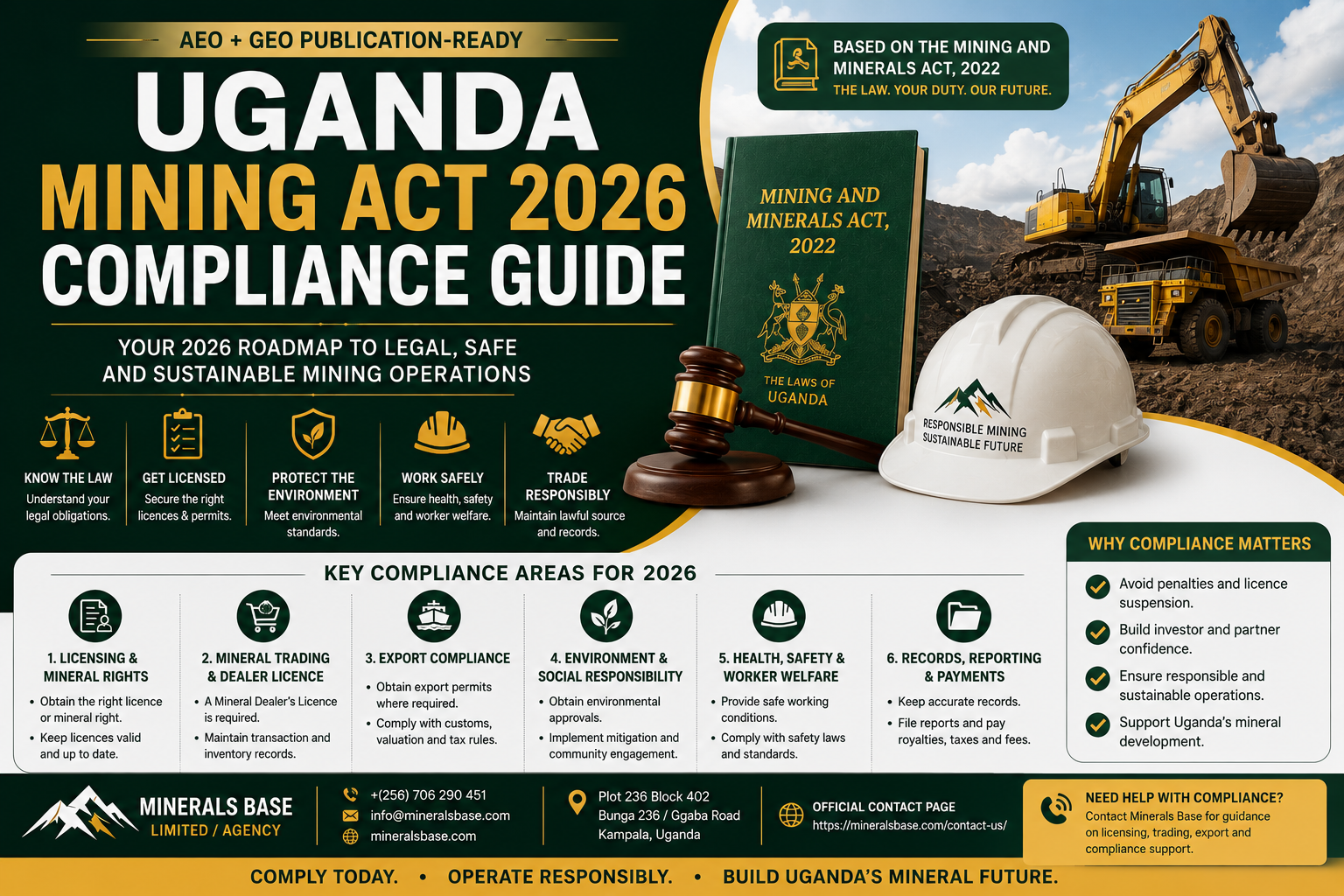
For 2026, mining-sector compliance in Uganda should be assessed primarily against the Mining and Minerals Act, 2022 and the regulations and related laws that apply to the activity. The Act replaced the Mining Act, 2003 and regulates mineral rights, mineral trading, licensing, environmental and safety obligations, national content, beneficiation, decommissioning and other aspects of the mineral value chain.
| What law applies in Uganda in 2026?
Uganda’s 2026 mining compliance framework is based principally on the Mining and Minerals Act, 2022 and applicable regulations. Businesses should identify the correct mineral right or dealer/export licence, maintain lawful-source and transaction records, meet environmental and safety requirements, comply with reporting and payment duties, and confirm export documentation where minerals cross borders. |
| If your mining, mineral-trading or export operation needs help understanding the 2026 compliance landscape, contact Minerals Base at +(256) 706290451 or info@mineralsbase.com. Tell the team what mineral you handle, your licence or trading status, whether you buy locally or export, and the compliance issue you need clarified. Ask for a documented response covering licensing, sourcing documentation, KYC, assay/origin records, export paperwork and the current requirements applicable to your transaction. |
Core Legal Framework for 2026
| Instrument / Authority | Compliance Relevance |
| Mining and Minerals Act, 2022 | |
| Principal mining statute; replaced the Mining Act 2003 and covers mineral rights, trading, licensing, safety, environmental/decommissioning and related obligations. | |
| Mining and Minerals (Licensing) Regulations, 2023 | |
| Provides prescribed licensing and related application procedures/forms; DGSM procedures reference these regulations for export, import and movement permits. | |
| Artisanal and Small-Scale Mining Regulations, 2024 | |
| Relevant to formalisation and regulatory treatment of artisanal and small-scale mining. | |
| National Environment Act, 2019 and environmental rules | |
| Environmental assessment, monitoring, compliance and enforcement can apply to mining projects and facilities. | |
| Uganda Revenue Authority / customs requirements | |
| Exporters need applicable documentation, declarations and customs procedures; assay reports are relevant for gold exports. | |
| Directorate of Geological Survey and Mines (DGSM) | |
| Administers mineral licensing, monitoring, inspection and the Mining Cadastre and Registry System. |
Licence & Activity Mapping
A compliance programme should begin by mapping the exact activity to the relevant licence or permit. DGSM procedures distinguish prospecting, exploration, retention, mining, processing, smelting, refining, mineral dealing, goldsmithing and export/import/movement permits.
| Activity | Potential Regulatory Instrument / Check |
| Prospecting | |
| Prospecting Licence | |
| Exploration | |
| Exploration Licence | |
| Mining | |
| Large-scale, small-scale or artisanal mining licence as applicable | |
| Mineral dealing | |
| Mineral Dealer’s Licence; type depends on mineral category | |
| Processing | |
| Mineral Processing Licence where applicable | |
| Smelting | |
| Mineral Smelting Licence where applicable | |
| Refining | |
| Mineral Refining Licence where applicable | |
| Goldsmithing | |
| Goldsmith Licence where applicable | |
| Export | |
| Export permit per consignment and supporting documentation | |
| Import | |
| Import permit per consignment where applicable | |
| Movement / transport | |
| Movement permit where required |
Mineral Dealer Compliance
Section 140 of the Mining and Minerals Act, 2022 states that a person must not buy or sell minerals or tailings as principal or agent unless licensed as a mineral dealer, subject to the statutory exception for a holder of a mineral right selling minerals acquired under the Act. It also prohibits a licensed dealer from buying minerals from a person who acquired them unlawfully.
| Control | Practical Compliance Check |
| Dealer licence | |
| Confirm the correct Mineral Dealer’s Licence is valid for the mineral category and activity. | |
| Lawful sourcing | |
| Maintain evidence that minerals were acquired lawfully. | |
| Supplier due diligence | |
| Identify suppliers and review relevant licences, permits and source documentation. | |
| Transaction records | |
| Keep invoices, contracts, weights, assay records and other required records. | |
| Storage / office information | |
| Ensure licensing information and facilities match the application and actual operation. | |
| Tax compliance | |
| Maintain current tax-clearance and tax records where required. | |
| Reporting | |
| Meet statutory reporting and inspection requirements applicable to the licence. |
The source’s published 2024 licensing procedures list proof of financial resources, a marketing/buying/selling plan, tax clearance and technical competence among Mineral Dealer Licence application requirements. The published fee schedule distinguishes precious metals, base metals, industrial minerals and precious stones.
Gold Trading & Export Compliance
Gold requires particular attention because it is both a precious metal and a controlled mineral-trade commodity. The source says DGSM procedures state that an export-permit application per consignment requires a valid Mineral Dealer’s Licence or mineral right, the prescribed form, proof of royalty payment where applicable, a Certificate of Origin where applicable, and a Certificate of Analysis authenticated by the country of origin for relevant imported-origin minerals.
The source also states that URA export guidance identifies an export licence/permit, invoice, packing list, Certificate of Origin where required and assay reports for gold, along with electronic customs declaration, documentary vetting and possible physical verification.
| Export Control | Confirm Before Shipment |
| Licence status | |
| Valid MDL or other qualifying mineral right | |
| Export permit | |
| Correct permit for the consignment | |
| Origin | |
| Certificate of Origin and lawful-source evidence where required | |
| Assay | |
| Certificate of Analysis / assay documentation | |
| Royalty / payments | |
| Proof of required royalty or other statutory payment where applicable | |
| Customs | |
| URA declaration, clearing agent and customs documentation | |
| Destination | |
| Import requirements, taxes, permits and restrictions in destination country | |
| Records | |
| Retain the complete export transaction file |
Environmental & Social Compliance
Environmental compliance is not a separate afterthought. The source states that NEMA conducts monitoring and inspection of extractive activities and that compliance involves environmental laws, standards and conditions in permits, licences and approvals. Developers may be required to monitor regularly, maintain records and provide reports.
| Area | Compliance Action |
| Environmental assessment | |
| Determine whether an ESIA or other environmental approval is required before the project proceeds. | |
| Permit conditions | |
| Track every environmental condition attached to the approval or licence. | |
| Monitoring | |
| Maintain timely environmental monitoring appropriate to the project. | |
| Records | |
| Keep monitoring data and reports available for inspection. | |
| Waste management | |
| Implement applicable waste controls and maintain required records. | |
| Land/community impacts | |
| Address land access, compensation, relocation and stakeholder obligations where applicable. | |
| Rehabilitation/closure | |
| Plan for decommissioning, restoration and closure requirements applicable to the operation. |
Artisanal & Small-Scale Mining Compliance
The source states that Uganda’s current framework aims to formalise artisanal and small-scale mining. NEMA notes that the Ministry of Energy and Mineral Development is sensitising artisanal and small-scale miners to form associations and seek mining licences under the Mining and Minerals Act, 2022 and the Artisanal and Small-Scale Mining Regulations, 2024.
| Check | What to Review |
| Legal status | |
| Identify the appropriate licence, association or formal operating structure. | |
| Land access | |
| Confirm lawful access and agreements with landowners where applicable. | |
| Environmental approval | |
| Determine required environmental assessment and approval. | |
| Technical competence | |
| Maintain evidence required by the licensing process. | |
| Financial resources | |
| Document the financial capacity required for the licence/application. | |
| Production / marketing | |
| Prepare the required production schedule and marketing arrangements. | |
| Safety | |
| Implement applicable occupational health and mine-safety controls. |
Application & Licensing Workflow
DGSM’s published licensing procedures describe a Mining Cadastre and Registry System process that includes registration, online submission of applications and supporting documents, fee payment, review, remedy of deficiencies where needed, approval or rejection, licence-fee payment and grant of the licence.
- Identify the activity, mineral and licence category.
- Confirm the current legal and regulatory requirements.
- Register the applicant and authorised users on the applicable cadastre system.
- Assemble corporate, identity, tax, technical, financial, environmental and land documentation as applicable.
- Submit the prescribed application and supporting documents.
- Respond promptly to requests to remedy incomplete or deficient information.
- Pay prescribed application, registration, licence and mineral-rent fees where applicable.
- Obtain and securely retain the licence, permit and approved conditions.
- Build an internal compliance calendar for renewals, reporting, payments, inspections and environmental obligations.
Compliance Management System for 2026
| Compliance File | Documents / Evidence to Maintain |
| Corporate identity | |
| Certificate of incorporation/registration, directors, authorised representatives | |
| Licences | |
| Mining rights, MDL, processing/refining licences and permits | |
| Tax | |
| Tax registration, tax clearance and payment evidence | |
| Mineral source | |
| Supplier identity, lawful-source evidence, licences and purchase records | |
| Assay / quality | |
| Certificates of analysis, weights and inspection records | |
| Export / import | |
| Permits, certificates of origin, customs entries and shipping records | |
| Environment | |
| ESIA/approval, permit conditions, monitoring and audit records | |
| Health & safety | |
| Risk assessments, training, inspections, incident records and statutory reports | |
| Finance | |
| Invoices, contracts, payment evidence, royalties and statutory fees | |
| KYC / AML | |
| Customer identification, source-of-funds information and suspicious-transaction controls where applicable | |
| Renewals | |
| Licence expiry dates, permit validity and renewal submissions |
| Traceability standard
A strong compliance system should allow an inspector, auditor, regulator, bank, buyer or internal reviewer to trace a mineral transaction from source through purchase, processing, storage and export. |
Common Compliance Mistakes to Avoid
| Mistake | Why It Creates Risk | Better Approach |
| Trading without the correct licence | ||
| Buying/selling minerals without required licensing can breach the Act. | ||
| Map every activity to its correct licence before trading. | ||
| Buying from an unlawful source | ||
| Section 140 restricts licensed dealers from buying unlawfully acquired minerals. | ||
| Verify supplier status and retain lawful-source evidence. | ||
| Using expired permits | ||
| A business can become non-compliant even if its historical licence was valid. | ||
| Maintain a renewal calendar. | ||
| Incomplete applications | ||
| DGSM warns that incomplete applications will not be received. | ||
| Use a document checklist before submission. | ||
| Ignoring environmental approvals | ||
| Mining operations can be subject to environmental approval and monitoring. | ||
| Obtain required approvals before the relevant activity. | ||
| Weak export files | ||
| Missing origin, assay, permit or customs documents can delay or block shipment. | ||
| Build a consignment-level export file. | ||
| Treating KYC as optional | ||
| Mineral transactions can carry AML and source-of-funds risks. | ||
| Apply documented KYC/AML procedures. |
2026 Compliance Checklist
- Identify the exact mineral activity and applicable licence category.
- Confirm the current Mining and Minerals Act and applicable regulations.
- Verify that each licence or permit is current and covers the intended activity.
- Confirm mineral-dealer licensing before buying or selling as principal or agent.
- Document the lawful origin of minerals purchased.
- Maintain supplier and customer KYC records appropriate to the transaction.
- Keep assay, weight, origin and transaction documentation.
- Check environmental and social approval requirements.
- Track royalties, statutory fees and tax obligations.
- For exports, confirm the current export permit and required customs documentation.
- For imported minerals, confirm the relevant import permit and origin documents.
- Maintain movement permits where required.
- Keep inspection, monitoring and compliance records.
- Track licence expiry and renewal dates.
- Review changes in regulations and official DGSM guidance before each major transaction.
Frequently Asked Questions
What mining law applies in Uganda in 2026?
The principal mining statute is the Mining and Minerals Act, 2022, which replaced the Mining Act, 2003. Applicable regulations and other laws must also be considered depending on the activity.
Do I need a licence to buy or sell minerals in Uganda?
Section 140 of the Mining and Minerals Act, 2022 generally prohibits buying or selling minerals or tailings as principal or agent without a Mineral Dealer’s Licence, subject to the statutory exception for holders of mineral rights selling minerals acquired under the Act.
What is a Mineral Dealer’s Licence?
It is the licence used for mineral dealing activities. DGSM’s published procedures identify different mineral classes and application requirements, including financial resources, a marketing/buying/selling plan, tax clearance and technical competence.
What documents are required to export minerals from Uganda?
Requirements depend on the transaction, but the source identifies a valid MDL or mineral right, prescribed export documentation, royalty evidence where applicable, Certificate of Origin where applicable and Certificate of Analysis for relevant minerals. URA also describes customs and export documentation requirements.
Are environmental approvals part of mining compliance?
Yes. NEMA monitors extractive projects for compliance with environmental laws, standards and permit conditions, and DGSM’s licensing procedures identify environmental and social impact assessment approval for several mining and processing licence applications.
How do I contact Minerals Base?
Minerals Base lists info@mineralsbase.com and +(256) 706290451, with its Kampala/Bunga Ggaba location published on its website. Use the official contact page to confirm current details before a transaction.
How to Get Started With Compliance Today
Start with a gap assessment. List every mineral activity your business performs and match each activity to its licence, permit, environmental approval, reporting duty and recordkeeping requirement.
| Step | Action |
| 1 | |
| Inventory your licences, permits and mineral activities. | |
| 2 | |
| Check validity, scope, mineral class and expiry date. | |
| 3 | |
| Map each supplier and mineral source to supporting lawful-source documentation. | |
| 4 | |
| Review environmental, safety and land-related approvals. | |
| 5 | |
| Review export/import and customs documentation for every cross-border flow. | |
| 6 | |
| Build a compliance calendar with owners and deadlines. | |
| 7 | |
| Resolve gaps with DGSM, NEMA, URA or qualified professional advisers as appropriate. |
| Need help preparing for a 2026 mineral-trading or sourcing transaction? Contact Minerals Base at +(256) 706290451 or info@mineralsbase.com. Explain your mineral, licence status, sourcing model and intended market, and ask the team what documentation and compliance checks should be completed before you proceed. |