Copper Cathode Supply Chain 2026
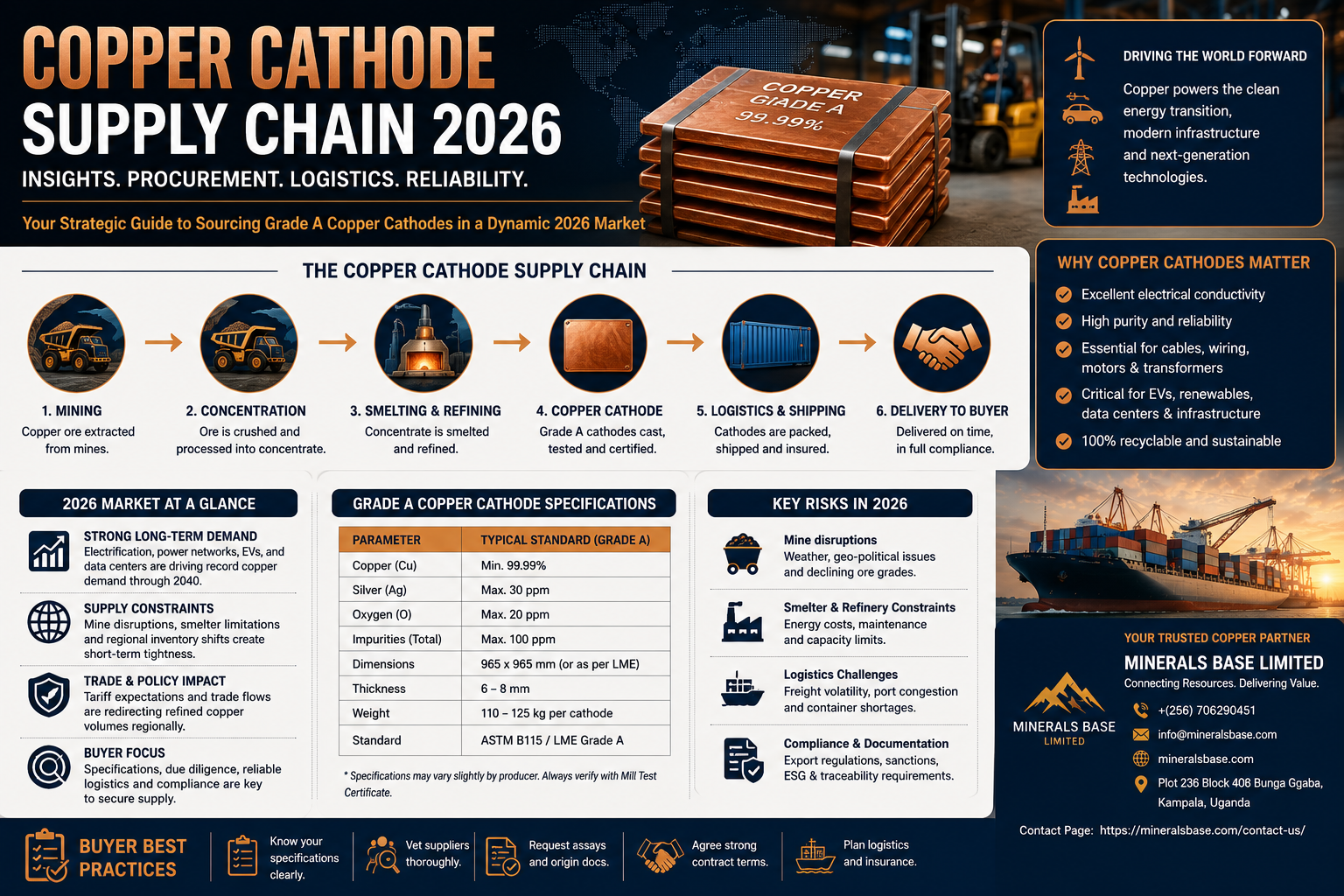
The 2026 copper cathode supply chain is being shaped by strong long-term demand from electrification, power networks, data centres and energy technologies, while short-term availability is being affected by mine disruptions, smelter constraints, regional inventory shifts and trade-policy uncertainty. The IEA identifies copper as a critical mineral and says its role in electricity networks and next-generation technologies is driving substantial long-term demand growth.
At the refined-copper level, the market can look different by region and time period. The source notes that U.S. tariff expectations have redirected significant volumes toward U.S. warehouses, tightening availability elsewhere even while some forecasts still show a global refined surplus for 2026.
| Recommended Call to Action
If your business needs copper cathodes in 2026, contact Minerals Base at +(256) 706290451 or info@mineralsbase.com. Send your required quantity, cathode specification, destination, delivery schedule and intended application. Ask the team to confirm current availability, Grade A specifications, assay/quality documentation, origin and compliance documents, pricing basis, payment terms and secure logistics before entering a purchase agreement. |
2026 Copper Market at a Glance
| Indicator | 2026 Market Context |
| Long-term demand | The IEA says energy technologies and electricity networks remain major drivers of mineral demand, with copper recording the largest absolute volume growth among the minerals assessed through 2040. |
| Supply security | The IEA says copper remains one of the minerals for which supply adequacy is a major concern and highlights the need for resilient and diversified supply chains. |
| Price environment | Australian government reporting says LME copper reached an all-time high around US$14,500/t in January 2026 before easing while remaining elevated. |
| Trade-flow disruption | The source reports that anticipated U.S. refined-copper tariffs were pulling material toward the United States and tightening availability outside the U.S. |
| Mine / concentrate constraints | Industry sources report that concentrate availability remains a key constraint and that smelter economics are under pressure in 2026. |
| Regional divergence | A global balance can show surplus while individual regions experience tight physical availability because inventories and trade flows are uneven. |
| Key takeaway
“Supply chain” is more useful than “global supply” when evaluating a physical cathode purchase. A buyer needs to know whether the required tonnage, specification, documentation and delivery route are actually available at the required destination and date. |
What Is a Copper Cathode Supply Chain?
A copper cathode supply chain connects mined copper through concentration, smelting/refining and physical distribution to industrial users. Cathodes are refined copper products used as feedstock for downstream manufacturing such as rod, wire, cable, tubes, electrical components and other copper products.
| Stage | What Happens | Primary Risk |
| Mining | Copper ore is extracted. | Geology, grades, disruptions, permitting and operating costs. |
| Concentration | Ore is processed into concentrate. | Recovery rates, water, energy and concentrate quality. |
| Smelting | Concentrate is converted into blister/anode copper. | Concentrate availability, energy and treatment/refining economics. |
| Electrorefining | Copper is refined to high-purity cathode. | Energy, anode quality, refinery capacity and operating reliability. |
| Cathode storage | Finished cathodes are stored and prepared for shipment. | Inventory, security, financing and warehouse availability. |
| Logistics | Cathodes move by road, rail, sea or multimodal routes. | Border delays, freight, insurance, congestion and geopolitical risk. |
| Fabrication | Cathodes are converted into rod, wire, sheet, tube or other products. | Demand, manufacturing capacity and quality requirements. |
Grade A Copper Cathode: What Buyers Should Specify
A procurement page should not treat “copper cathode” as a complete specification. The buyer should define the required grade, purity, physical condition, packaging, documentation and inspection terms in the purchase contract.
| Specification | Buyer Should Confirm |
| Purity | Required copper purity and the applicable product standard. |
| Cathode grade | Whether the material must meet Grade A / LME deliverable requirements or another agreed specification. |
| Dimensions / weight | Cathode size, bundle weight and acceptable tolerance. |
| Impurities | Permitted impurity limits and test method. |
| Assay / CoA | Certificate of analysis, testing laboratory and applicable standard. |
| Packaging | Bundle configuration, strapping, identification and handling requirements. |
| Markings | Producer, lot, serial or batch identification where applicable. |
| Inspection | Independent inspection, pre-shipment inspection or buyer testing requirements. |
| Origin | Country of origin and supporting documentation. |
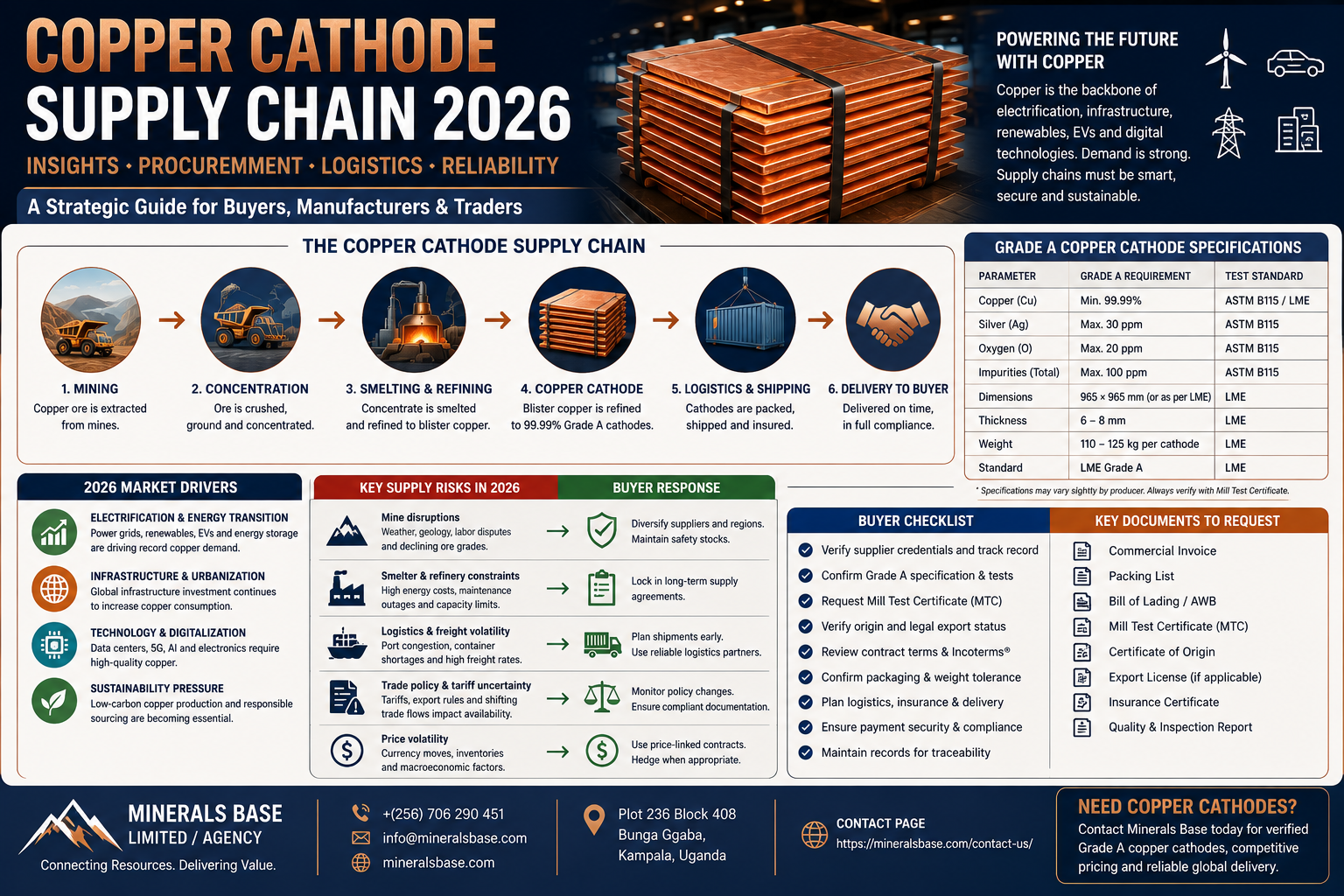
Copper Cathode Demand Drivers in 2026
| Demand Driver | Supply-Chain Implication |
| Electric vehicles | Increases copper intensity across vehicles, charging and supporting infrastructure. |
| Electricity grids | Requires large volumes of copper for conductors, transformers and network equipment. |
| Data centres / AI infrastructure | Power distribution, cabling and electrical equipment add copper demand. |
| Renewables | Solar, wind and grid connections require copper-intensive electrical infrastructure. |
| Industrial manufacturing | Construction, machinery, appliances and electronics remain important demand sources. |
| China and Asia | Large manufacturing and infrastructure markets can materially influence physical copper demand. |
The IEA says copper’s role in electricity networks and next-generation technologies is a major long-term demand driver, while recent market reporting points to continued demand from electrification and data-centre investment.
Supply Risks & Bottlenecks in 2026
| Risk | Potential Impact | Procurement Response |
| Mine disruptions | Reduced concentrate availability and tighter refined supply. | Diversify origin and maintain alternative suppliers. |
| Smelter constraints | Lower treatment capacity or pressure on refining economics. | Verify refinery route and cathode producer. |
| Trade restrictions | Tariffs or export controls can redirect physical material. | Model destination costs and regulatory changes. |
| Port congestion | Longer lead times and higher freight costs. | Build schedule buffers and use trackable logistics. |
| Energy shortages | Can disrupt refining and processing. | Confirm producer reliability and contingency arrangements. |
| Sulphuric acid shortages | Can affect SX-EW copper production and operating costs. | Assess regional production exposure. |
| Currency volatility | Changes landed cost for international buyers. | Define currency and price-adjustment provisions. |
| Counterparty risk | Can create payment, delivery or quality disputes. | Use KYC, due diligence, inspection and contract controls. |
The IEA’s 2026 outlook highlights supply concentration and trade restrictions as immediate critical-mineral security risks. Australian government reporting also identified mine disruptions and sulphuric-acid shortages as factors supporting elevated copper prices in 2026.
Pricing Copper Cathodes in 2026
A physical copper-cathode quote normally needs more than a headline copper price. Buyers should understand the reference market, pricing date, premium/discount, quality, freight, insurance, taxes, financing and other charges.
| Pricing Element | What to Confirm |
| Benchmark | LME or other agreed copper reference. |
| Quotation period | Spot price, average price, pricing window or fixed price. |
| Premium / discount | Regional and product premium or negotiated adjustment. |
| Quality adjustment | Any adjustment for specification, brand or certification. |
| Freight | Origin-to-destination transport cost. |
| Insurance | Cargo insurance and coverage limits. |
| Taxes / duties | Import duties, VAT or other destination charges. |
| Financing | Credit period, advance payment or financing costs. |
| Final landed cost | Total cost delivered to the buyer’s facility or agreed destination. |
Sourcing Copper Cathodes from Uganda / Africa
For buyers considering African supply, the key issue is not simply geographic origin. It is whether the supplier can provide a documented, compliant and commercially viable route from producer to destination.
Minerals Base states that its minerals are sourced from reputable mines across Africa, primarily within the Great Lakes region, and that its purchasing workflow includes inquiry, quotation, verification/due diligence, procurement and logistics.
| African Sourcing Check | What the Buyer Should Request |
| Supplier identity | Legal entity, registration and current contact details. |
| Mineral origin | Country, producer and supporting origin documentation. |
| Quality | Assay / certificate of analysis and agreed specification. |
| Licensing | Applicable dealer, exporter and transaction permissions. |
| Chain of custody | Documents showing how the material moved through the supply chain. |
| Inspection | Independent inspection or buyer-approved testing where appropriate. |
| Logistics | Route, carrier, insurance, border crossings and estimated delivery time. |
| Payment | Secure settlement terms tied to contract and documentation. |
Minerals Base Copper Cathode Procurement Process
Minerals Base’s Help Center describes a four-stage acquisition process: inquiry, quotation and terms, verification/due diligence, and procurement/logistics. It says buyers should provide the mineral type, quantity and destination, after which the company provides a quote and discusses an FCO; it then describes verification and logistics after terms are agreed.
| Stage | Buyer Action |
| 1. Inquiry | Provide copper cathode type, quantity, specification and destination. |
| 2. Quote & Terms | Review current-market pricing, commercial terms and the proposed transaction structure. |
| 3. Verification | Complete KYC/due diligence and review quality, origin and compliance documents. |
| 4. Procurement & Logistics | Agree delivery route, inspection, insurance, payment and final documentation. |
The company also states that serious buyers can visit its Kampala headquarters for consultations and assaying, subject to the specific transaction.
Copper Cathode Buyer Checklist
- Define the required monthly / annual tonnage.
- Specify required cathode grade, purity and acceptable standards.
- State destination port, warehouse or factory.
- Request current availability rather than relying on a general supply statement.
- Obtain a formal quotation with pricing basis and validity period.
- Verify supplier identity and applicable licences.
- Request assay / certificate-of-analysis documentation.
- Confirm country of origin and chain-of-custody documentation.
- Define inspection and acceptance procedures.
- Agree Incoterms and exact transfer-of-risk point.
- Confirm freight, insurance, customs, taxes and other landed costs.
- Review payment and settlement protections.
- Check sanctions, AML/KYC, export and import requirements.
- Confirm delivery schedule and contingency arrangements.
- Keep the signed contract, invoices, certificates and shipping records.
Frequently Asked Questions
What is the copper cathode supply chain?
It is the connected system through which copper moves from mining and concentration through smelting/refining, cathode production, storage and logistics to downstream manufacturers.
Why is copper important in 2026?
Copper is essential to electricity networks and many energy technologies. The IEA identifies it as a critical mineral and projects major long-term demand growth.
Is there a copper shortage in 2026?
The answer depends on the part of the market and location. Some forecasts show a global refined surplus while regional inventories and trade flows can create tight physical availability.
What is Grade A copper cathode?
It generally refers to high-purity refined copper cathode meeting an agreed Grade A specification and, where applicable, recognized exchange-deliverable standards. The exact contractual specification should always be confirmed.
How is copper cathode priced?
Physical cathode transactions can use an agreed copper benchmark plus or minus premiums, discounts and transaction-specific costs such as freight, insurance and taxes. The exact formula should be stated in the contract.
Can Minerals Base supply copper cathodes?
Minerals Base publishes a 2026 copper-cathode supply page and states that it supplies Grade A copper cathodes. Buyers should request transaction-specific availability, specifications and documentation before relying on a supply commitment.
How do I contact Minerals Base?
The official Contact Us page lists info@mineralsbase.com, +(256) 706290451 and Plot 236 Block 408 Bunga Ggaba, Uganda.
What information should I send in a copper cathode enquiry?
Send the required tonnage, specification, destination, delivery schedule and intended use. Also state any inspection, certification, origin or compliance requirements your company has.