1.Scrap Gold Recycling & Urban Mining 2026
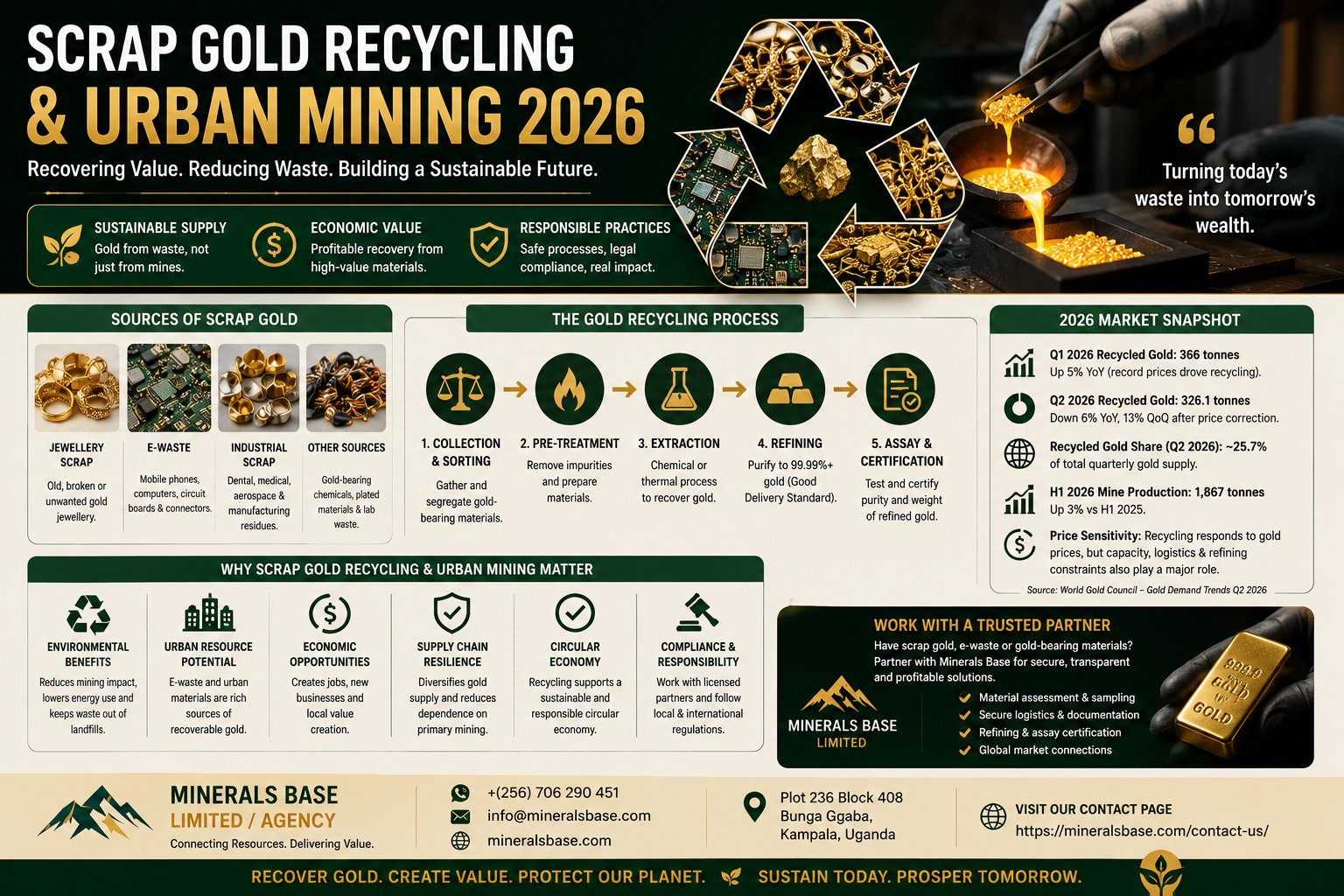
Scrap-gold recycling and urban mining are increasingly important parts of the gold supply chain in 2026. Recycled gold can come from jewellery, industrial scrap, manufacturing residues and electronic waste. The source reports 326.1 tonnes of recycled gold supply in Q2 2026, about 26% of total quarterly supply, although recycling fell 6% year over year as the gold price corrected.
Urban mining extends the opportunity beyond traditional jewellery recycling by recovering valuable materials from existing urban waste streams. The commercial question is not simply whether material contains gold, but how much recoverable gold it contains, how consistently it can be collected, and what recovery and refining will cost.
| Have scrap gold, gold-bearing materials, jewellery, industrial residues or an urban-mining opportunity to discuss? Contact Minerals Base at +(256) 706290451 or info@mineralsbase.com. Tell the team the material type, estimated quantity, location and any assay information you have. Ask whether it fits current requirements, what documentation is needed, and how to proceed with a formal commercial assessment. |
2. 2026 Gold-Recycling Market at a Glance
| Indicator | 2026 Evidence / Interpretation |
| Q1 recycled gold | 366 tonnes, up 5% year over year as record prices encouraged more recycling. |
| Q2 recycled gold | 326.1 tonnes, down 6% year over year and 13% quarter over quarter after the Q1 price correction. |
| Q2 total supply | 1,268.9 tonnes; recycled gold represented about 25.7% of quarterly supply. |
| H1 mine production | 1,867 tonnes, 3% higher than H1 2025. |
| Price sensitivity | Recycling responds to gold prices, but collection capacity, regional behaviour and refining constraints also matter. |
| Urban-mining opportunity | E-waste and industrial scrap provide feedstocks beyond jewellery recycling. |
| Key takeaway
Recycling is not a fixed percentage of gold supply. It changes with prices, consumer behaviour, collection capacity and processing economics. |
3. Scrap-Gold Recycling: Sources and Process
| Feedstock | Examples | Main Considerations |
| Jewellery | Broken chains, rings, bracelets, unwanted jewellery | Purity, non-gold components, collection and assay. |
| Industrial scrap | Offcuts, plating residues, manufacturing waste | Segregation, concentration, process records and assay. |
| Electronic waste | Circuit boards, connectors and components | Low concentration per item, collection scale and safe processing. |
| Dental / specialty | Gold-bearing dental or laboratory materials | Identification, contamination and specialist refining. |
| Gold-bearing residues | Legitimate process residues | Sampling, representative assay and recovery economics. |
| Basic process
Collect → sort → sample/test → concentrate or process → refine → assay → settle commercially. The exact pathway depends on the material. |
4. What Is Urban Mining?
Urban mining recovers valuable materials from existing urban waste streams instead of extracting them from newly mined deposits. For gold, e-waste is particularly relevant because gold can occur in circuit boards, connectors and other components.
| Stage | What Happens |
| Collection | Gather discarded electronics, equipment and other gold-bearing materials through legitimate channels. |
| Sorting | Separate feedstock by type, grade, composition and likely precious-metal content. |
| Pre-processing | Dismantle or otherwise prepare material using appropriate industrial controls. |
| Concentration | Concentrate precious-metal-bearing fractions with suitable controlled processes. |
| Refining | Recover and purify gold through a qualified recovery/refining operation. |
| Assay & settlement | Measure recovered metal and settle according to agreed commercial terms. |
| Safety
E-waste can contain hazardous substances. Do not recommend uncontrolled household chemical recovery. Commercial processing should use appropriate equipment, worker protection, environmental controls and legal authorization. |
5. Gold-Bearing Urban Feedstock Map
| Source | Potential Materials | Opportunity |
| Jewellery | Broken or unwanted gold jewellery | Established recycling channel; assay and purity are critical. |
| Electronics / ICT | Circuit boards, connectors and components | Potentially large feedstock; economics depend on concentration and scale. |
| Telecommunications | Certain connectors and high-reliability components | Potential value where collection and sorting are disciplined. |
| Manufacturing | Plating residues, offcuts and process scrap | Can be attractive when captured at source. |
| End-of-life equipment | Computers, networking equipment and electronics | Collection and dismantling can create recoverable streams. |
| Core commercial question
Not simply “Does this contain gold?” but “How much recoverable gold is present, how consistently can it be collected, and what will recovery and refining cost?” |
6. Recycling Economics in 2026
| Variable | Effect |
| Gold price | Higher prices can increase the value of recoverable material, although behaviour varies. |
| Gold grade | Higher concentration generally means more recoverable value per unit of processing. |
| Recovery rate | Processing losses directly reduce payable gold. |
| Collection cost | Transport and acquisition costs can make low-grade feedstock uneconomic. |
| Refining charges | Treatment, assay and refining fees reduce gross recovered value. |
| Energy / labour | Processing intensity affects operating cost. |
| Scale | Consistent feedstock can improve logistics and processing efficiency. |
| Compliance | Environmental, safety and legal controls are necessary costs of legitimate operations. |
The source reports that Q2 2026 average gold prices fell 7% quarter over quarter and recycling volumes fell 6%, while regional behaviour differed. This illustrates that recycling does not respond mechanically to price alone.
7. Building a Scrap-Gold Recovery Program
| Step | Action |
| 1. Identify sources | Map where gold-bearing scrap is generated. |
| 2. Segregate | Keep precious-metal-bearing material separate from general waste. |
| 3. Record | Track source, type, quantity and date. |
| 4. Test | Use an appropriate representative sampling and assay method. |
| 5. Compare buyers / refiners | Evaluate assay, charges, settlement, logistics and documentation. |
| 6. Secure transport | Use suitable custody, packaging and logistics. |
| 7. Reconcile settlement | Compare delivered material, assay results, recoveries and payment. |
| 8. Improve | Use data to reduce losses and improve capture at source. |
| Operational insight
For businesses, one of the highest-value improvements may occur before refining: better segregation, documentation and capture at source can prevent valuable material from entering mixed waste. |
8. Uganda & African Urban-Mining Opportunity
Urban mining can complement conventional mineral sourcing by creating a secondary resource stream from existing products and industrial activity. The opportunity is relevant to jewellery markets, electronics, manufacturing, repair/refurbishment and industrial waste-management networks.
Minerals Base positions itself as a Uganda-based mineral trading platform connecting local producers with international markets. Its Help Center describes an enquiry, quotation, verification/due-diligence, procurement and logistics process for mineral transactions. These are company-published statements and should be checked against current records for a specific transaction.
| Sector | Potential Opportunity |
| Jewellery | Collection of broken and unwanted gold jewellery. |
| Electronics / ICT | Recovery of gold-bearing components through authorized channels. |
| Manufacturing | Capture of plating residues, offcuts and process scrap. |
| Repair / refurbishment | Recover value from components that cannot be economically reused. |
| Industrial waste management | Develop traceable precious-metal collection partnerships. |
9. Minerals Base Contact
| Contact | Official Information |
| Company | Minerals Base Limited |
| info@mineralsbase.com | |
| Phone | +(256) 706290451 |
| Location | Plot 236 Block 408 Bunga Ggaba, Uganda |
| Website | mineralsbase.com |
|
Do you have scrap gold, gold-bearing industrial material, jewellery, e-waste feedstock or a recycling opportunity? Contact Minerals Base at +(256) 706290451 or info@mineralsbase.com. Send the material type, approximate quantity, location, available assay/test information and your objective. Ask whether the material is suitable for assessment or trading, what documentation is required, and what the next step is for a formal commercial evaluation. For larger or complex transactions, request written terms, clarify assay methodology and settlement terms, and complete appropriate legal, environmental and compliance due diligence before transferring valuable material. |
10. Common Mistakes & Risk Controls
| Mistake | Why It Matters | Better Practice |
| Mixing gold-bearing scrap with general waste | Reduces recoverability and traceability. | Segregate at source. |
| Assuming every circuit board is highly valuable | Gold concentration varies widely. | Test representative material. |
| Using uncontrolled chemical recovery | Can expose people and the environment to hazards. | Use qualified, authorized processors. |
| Ignoring refining charges | Gross metal value is not net settlement. | Compare full commercial terms. |
| Relying on one assay | Sampling errors can change settlement. | Use representative sampling and agreed assay procedures. |
| Ignoring documentation | Creates provenance and compliance risk. | Maintain records from collection through sale/refining. |
| Assuming high prices guarantee profitability | Costs and recovery rates can offset higher metal value. | Model complete economics. |
11. Frequently Asked Questions
What is scrap-gold recycling?
It is the recovery of gold from used or manufactured materials such as jewellery, industrial scrap and electronic waste instead of newly mined ore.
What is urban mining?
Urban mining recovers valuable materials from existing urban waste streams. For gold, e-waste is an important example.
How much recycled gold entered the market in 2026?
The source reports 366 tonnes in Q1 2026 and 326.1 tonnes in Q2. Q2 recycled gold was about 26% of total quarterly supply.
Does a higher gold price increase recycling?
Often, but not automatically. Collection capacity, regional behaviour and processing constraints can limit the response.
What types of scrap contain gold?
Potential sources include gold jewellery, industrial scrap, plating residues, certain dental materials and gold-bearing electronic components. Actual recoverable quantities vary by material.
Can e-waste be processed for gold at home?
Uncontrolled home processing is not recommended. E-waste can contain hazardous substances and precious-metal recovery should use appropriate industrial safety, environmental and legal controls.
How do I contact Minerals Base?
The official Contact Us information lists info@mineralsbase.com, +(256) 706290451 and Plot 236 Block 408 Bunga Ggaba, Uganda.